Home
 ReportReport
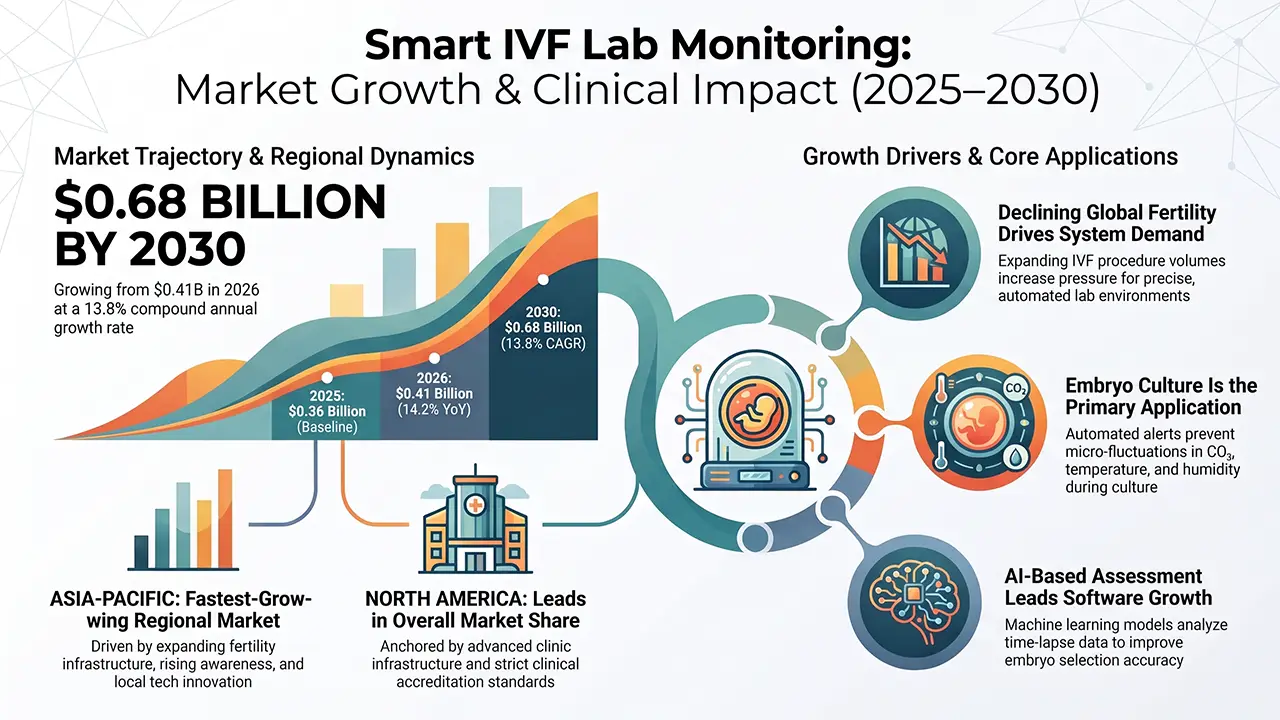
The global smart IVF lab monitoring market, valued at USD 0.41 billion in 2026, is projected to reach USD 0.68 billion by 2030 at a 13.8% CAGR. Rising infertility rates, growing adoption of real-time lab automation, and AI-driven monitoring platforms are fueling strong global demand across North America and Asia-Pacific.



The IVF laboratory is the most sensitive and consequential environment in reproductive medicine. Within its closely controlled walls, embryos are cultured, cryopreserved, assessed, and transferred, every parameter critical to the outcome. Temperature variations of a single degree Celsius, CO₂ fluctuations within fractions of a percent, or uncontrolled humidity can compromise embryo viability and reduce the probability of a successful live birth. Smart IVF lab monitoring has emerged as the technology sector purpose-built to eliminate these risks through connected sensors, real-time analytics, automation, and intelligent cloud-based platform management, transforming the IVF laboratory from a manually managed environment into a continuously monitored, intelligently managed clinical operation.
The global smart IVF lab monitoring market was valued at USD 0.36 billion in 2025, grew to USD 0.41 billion in 2026 at a growth rate of 14.2%, and is projected to reach USD 0.68 billion by 2030 at a CAGR of 13.8% from 2026 to 2030, according to The Business Research Company. This double-digit CAGR positions smart IVF lab monitoring among the fastest-growing segments in the global reproductive healthcare technology landscape, a reflection of both the urgency of clinical demand and the maturity of enabling technologies, IoT sensors, cloud platforms, AI analytics, and process automation, that are converging to serve this high-stakes environment.
The smart IVF lab monitoring market entered the forecast period from a base of USD 0.36 billion in 2025, accelerating to USD 0.41 billion in 2026 and is expected to sustain its remarkable momentum through 2030, when the market is forecast to stand at USD 0.68 billion, a near-doubling of market size over five years. This is an industry propelled by three structural clinical realities: growing evidence that environmental precision in IVF laboratories directly correlates with improved embryo quality; rising regulatory scrutiny of IVF laboratory protocols; and the technological convergence of IoT, cloud computing, and AI that has made intelligent lab monitoring both clinically viable and commercially accessible for fertility clinics of all sizes.
Smart in vitro fertilization (IVF) lab monitoring is an intelligent laboratory management system that uses connected devices, sensors, automation, and data analytics to monitor critical IVF lab parameters, including temperature, humidity, air quality, and equipment performance, in real time. It supports improved embryo safety, operational efficiency, regulatory compliance, and consistent fertility treatment outcomes. Core services include predictive maintenance alerts, remote system diagnostics, quality control analytics, workflow automation, and optimisation, collectively elevating the IVF laboratory into a data-driven clinical environment in which deviations from optimal conditions are detected and corrected in real time, before they can affect embryo viability or treatment outcome.
The primary growth driver is the escalating global burden of infertility, which continuously expands IVF procedure volumes and with them, the demand for precise laboratory infrastructure. The scale of this challenge is well-documented: in August 2025, the Office for National Statistics (ONS), a UK government department, confirmed that the total fertility rate (TFR) in England and Wales remained at a historic low of 1.41 children per woman in 2024, compared with 1.42 in 2023, continuing a decade-long decline. As infertility rates drive increased IVF cycle volumes, the pressure on IVF laboratories to operate with greater precision, efficiency, and documented safety grows in direct proportion, expanding the addressable market for smart IVF lab monitoring solutions.
Increasing regulatory scrutiny and compliance requirements in fertility treatments are creating a structural imperative for smart monitoring adoption. Health authorities in multiple jurisdictions are tightening standards for IVF laboratory environmental control, documentation, and quality assurance, requirements that are difficult to meet cost-effectively through manual protocols alone. Smart IVF lab monitoring systems provide the continuous, time-stamped, auditable environmental records that regulatory compliance frameworks demand, driving adoption as a clinical necessity rather than a discretionary investment.
Growing demand for high-precision environmental stability is a direct clinical driver. Embryos at the blastocyst stage are extraordinarily sensitive to micro-variations in incubator conditions, CO₂ concentration, pH, temperature, and VOC levels. Key protocol innovations driving adoption include incubator opening frequency minimisation, a clinical practice limiting incubator access to reduce embryo culture disruption and cryopreservation quality assurance scheduling, continuous verification of cryogenic storage conditions for vitrified embryos and oocytes over months or years. Both create persistent, long-term platform revenue within each fertility clinic.
Rapid expansion of fertility services across Asia-Pacific, Latin America, and the Middle East generates a growing pipeline of new IVF clinic installations requiring smart monitoring infrastructure from day one. These new deployments in markets where smart monitoring is not yet standard practice represent a significant addressable market opportunity complementing the upgrade cycle in established markets.

The smart IVF lab monitoring market is segmented by component into hardware, software, and services, three interdependent layers constituting the intelligent laboratory monitoring ecosystem. The hardware segment encompasses connected physical devices forming the sensory layer of any smart monitoring deployment: environmental monitoring sensors, temperature monitoring devices, humidity monitoring devices, carbon dioxide and oxygen monitoring systems, and air quality and VOC sensors. These instruments are the primary data collection points in the IVF laboratory, and their accuracy and connectivity standards directly determine the clinical quality of insights derived from the broader monitoring system. Hardware represents the largest revenue component, driven by the capital cost of sensors and monitoring devices deployed across laboratory spaces, incubators, and cryogenic storage systems.
The software segment, encompassing IVF laboratory management software, cloud-based monitoring platforms, embryo monitoring software, AI-based embryo assessment software, and data analytics and reporting software, is the intelligence layer of smart IVF lab monitoring. AI-based embryo assessment software is the highest-growth sub-segment, leveraging machine learning models trained on time-lapse microscopy data to evaluate embryo viability and improve the precision and consistency of embryo selection decisions. The cloud-based monitoring platform sub-segment is also growing rapidly, driven by multi-clinic networks seeking centralized real-time visibility across all laboratory sites. The services segment, covering real-time monitoring, remote lab monitoring, installation and integration, calibration and validation, and equipment maintenance, provides the ongoing operational infrastructure keeping monitoring systems at clinical specification.
Embryo culture monitoring is the most clinically critical and commercially dominant application, directly addressing the maintenance of stable incubator conditions, CO₂, temperature, pH, and humidity throughout the culture phase. Any parameter deviation can affect cell division rates, blastocyst formation, and embryo quality available for transfer. Smart monitoring provides continuous automated alerts when parameters drift outside defined thresholds, enabling clinical intervention before embryo viability is compromised.
Environmental condition monitoring covers the broader laboratory environment, air quality, particulate counts, VOC levels, and pressure differentials, ensuring the entire clinical airspace meets stringent standards for gamete and embryo handling. Cryogenic storage monitoring safeguards the long-term integrity of vitrified embryos, oocytes, and sperm, delivering continuous temperature and liquid nitrogen level alerts that prevent catastrophic failures and irreversible patient sample loss. Sample tracking and witnessing implements electronic double-witnessing protocols, ensuring the correct gametes or embryos are used with the correct patient at every workflow stage, eliminating one of the most serious clinical liability risks in fertility medicine. Equipment performance monitoring and IVF workflow management round out the landscape, with the latter an emerging growth segment as clinics seek end-to-end digital integration of clinical operations, patient data management, and laboratory workflow within unified smart monitoring platforms.
North America was the largest region in the smart IVF lab monitoring market in 2025, anchored by the United States' world-leading fertility clinic infrastructure, high per-clinic investment capacity, and strong regulatory drivers, including compliance requirements from the Joint Commission and College of American Pathologists (CAP), that mandate documented laboratory environmental monitoring as a condition of clinical accreditation. The US market is characterized by high awareness among clinic directors of the clinical and liability benefits of continuous smart monitoring and a well-established ecosystem of vendors, system integrators, and clinical advisors serving the fertility sector.
Asia-Pacific is the fastest-growing regional market in the forecast period, fuelled by explosive growth of IVF clinic infrastructure across China, India, Japan, South Korea, and Australia, combined with rising infertility awareness and increasing healthcare investment. India is emerging as a centre of both IVF market growth and domestic innovation: in January 2025, SpOvum Technologies launched its Integrated IVF Management Solution MaaS platform. In May 2025, SpOvum partnered with Khushi Fertility & IVF Centre to deploy AI-powered IVF lab management and smart IVF lab monitoring solutions, illustrating the depth of domestic innovation and institutional adoption momentum. China's expansion of private fertility clinic networks, Japan's high clinical precision standards, and South Korea's government support for ART collectively reinforce Asia-Pacific's position as the market's most dynamic regional growth engine.
Western Europe represents a substantial and mature market, underpinned by advanced fertility clinic infrastructure in Germany, France, the UK, Spain, and the Netherlands, and a rigorous regulatory environment creating strong compliance-driven demand for smart monitoring. Eastern Europe is emerging, with expanding clinic networks in Poland, the Czech Republic, and the Balkans. South America, the Middle East, and Africa complete the global picture, with Brazil, the UAE, and Saudi Arabia identified as the leading country-level growth markets in their respective regions.
The global smart IVF lab monitoring market is at an inflection point. Growing from USD 0.36 billion in 2025 to USD 0.68 billion by 2030 at a double-digit CAGR of 13.8%, it represents one of the fastest-growing technology niches in reproductive healthcare, an intersection of IoT, AI, cloud computing, and clinical precision medicine that is reshaping IVF laboratory operations globally. The drivers are structural and self-reinforcing: rising infertility rates expand IVF volumes; expanding volumes demand greater laboratory precision; precision demands drive smart monitoring adoption; and smart monitoring adoption improves clinical outcomes, validating further investment. This feedback loop ensures the market's growth is durable and compounding.
For technology providers, the roadmap is defined by platform integration depth, AI analytics capability, regulatory clearance strategy, and geographic expansion, particularly into Asia-Pacific, where the largest volume growth opportunity resides. For fertility clinic operators, smart monitoring is transitioning from a discretionary investment to a clinical and regulatory imperative. For investors and healthcare strategists, the smart IVF lab monitoring opportunity through 2030 combines a compelling market trajectory, proven clinical value, and a technology ecosystem mature enough to deliver at scale, making it one of the most clearly defined growth stories in the broader fertility healthcare technology landscape.



The University of Aberdeen has launched a redesigned, free IVF success calculator, the OPIS tool, powered by updated national HFEA data. Built with patients at its centre, the IVF success calculator provides tailored success estimates across up to six IVF or ICSI cycles, helping couples plan emotionally, physically, and financially.

A retrospective cross-sectional study of 276 ART patients suggests that the oestradiol-to-oocyte ratio (EOR) could serve as a meaningful prognostic marker for IVF outcomes in PMOS. The research examines EOR across four categories, incorporating subgroup analysis by luteinising hormone activity during ovarian stimulation.

AutoIVF's OvaReady device is advancing IVF egg retrieval technology by recovering "stealth oocytes" from discarded follicular fluid. With Northeastern University co-op students Tori Christianson and Jake Percival refining its prototypes, the Natick, Mass, based startup is preparing for clinical trials, aiming for FDA clearance to improve IVF success rates.
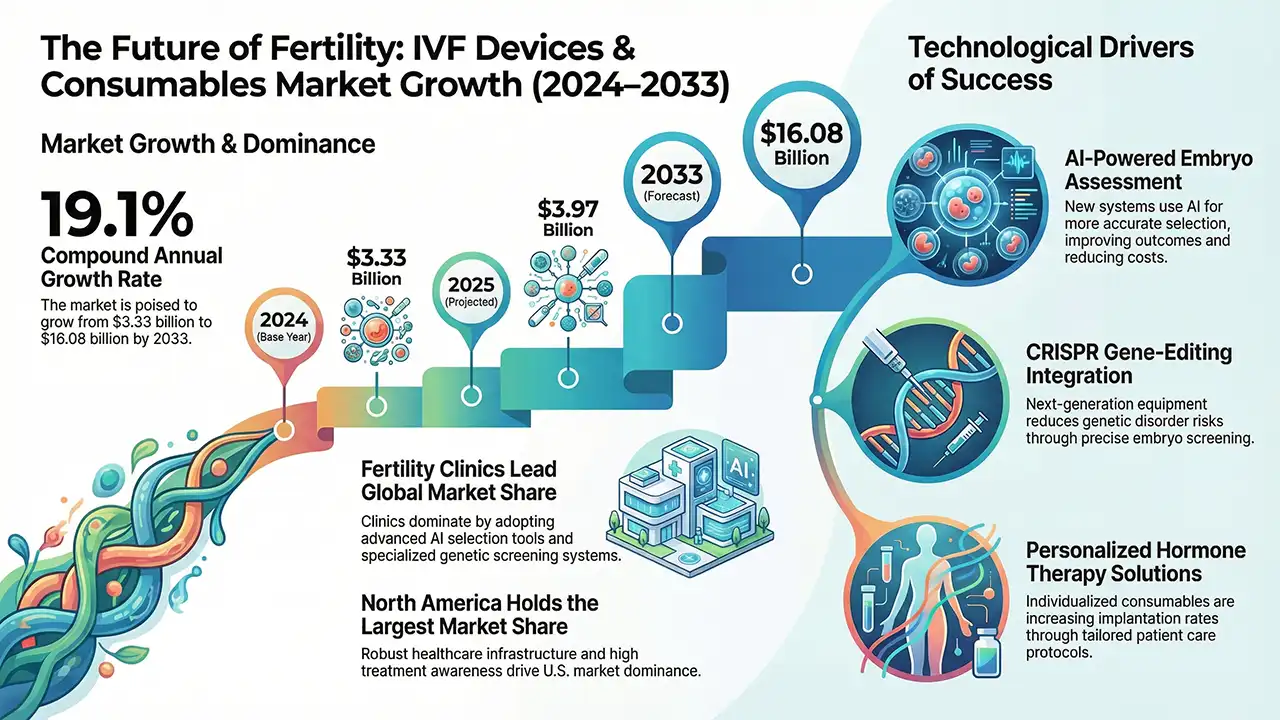
The global IVF Devices and Consumables market is projecting a significant surge to $16.08 billion by 2033. Driven by rising infertility and tech innovations, the analysis covers regional shifts, product segments, and emerging trends, highlighting the industry’s evolution alongside the growing Smart Fertility Tracker Market
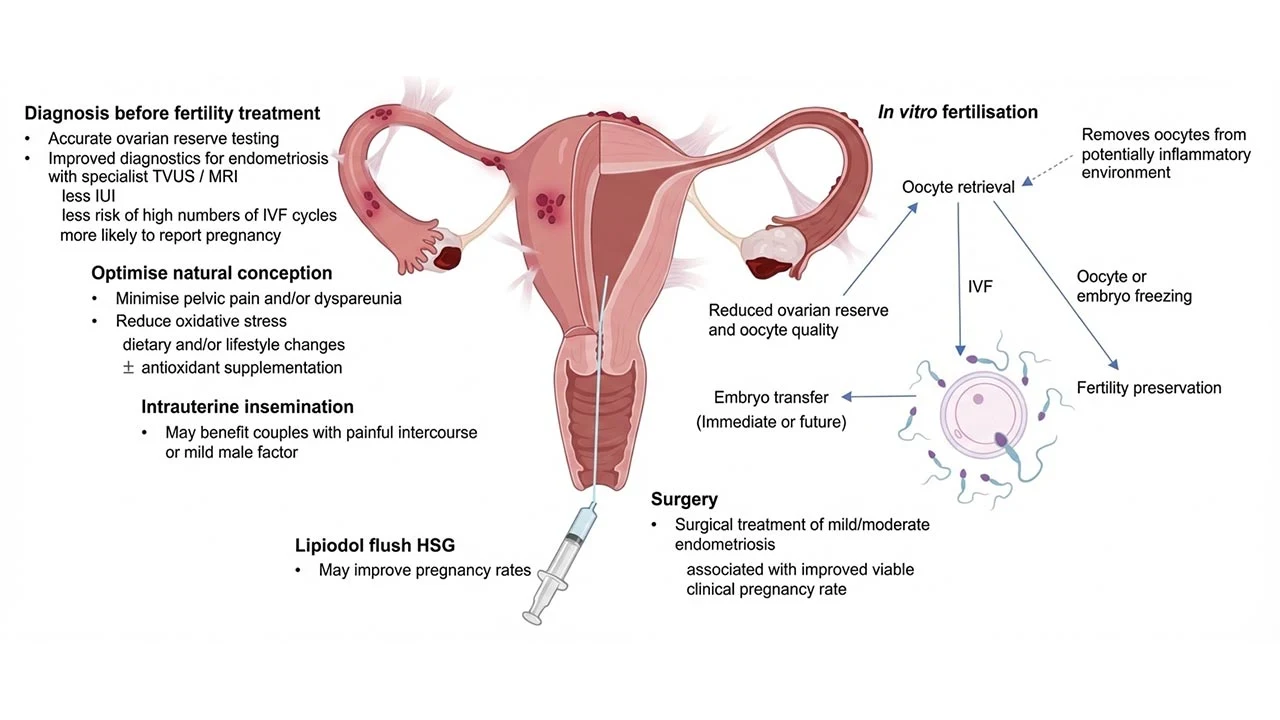
Integrating IVF and Surgical Management in Endometriosis offers a patient-centered strategy to improve fertility while managing chronic pain. By integrating laparoscopic surgery, ovarian reserve assessment, and assisted reproductive technology, clinicians can tailor treatment plans, enhance live birth rates, and optimize reproductive outcomes for women facing complex endometriosis-related infertility challenges.
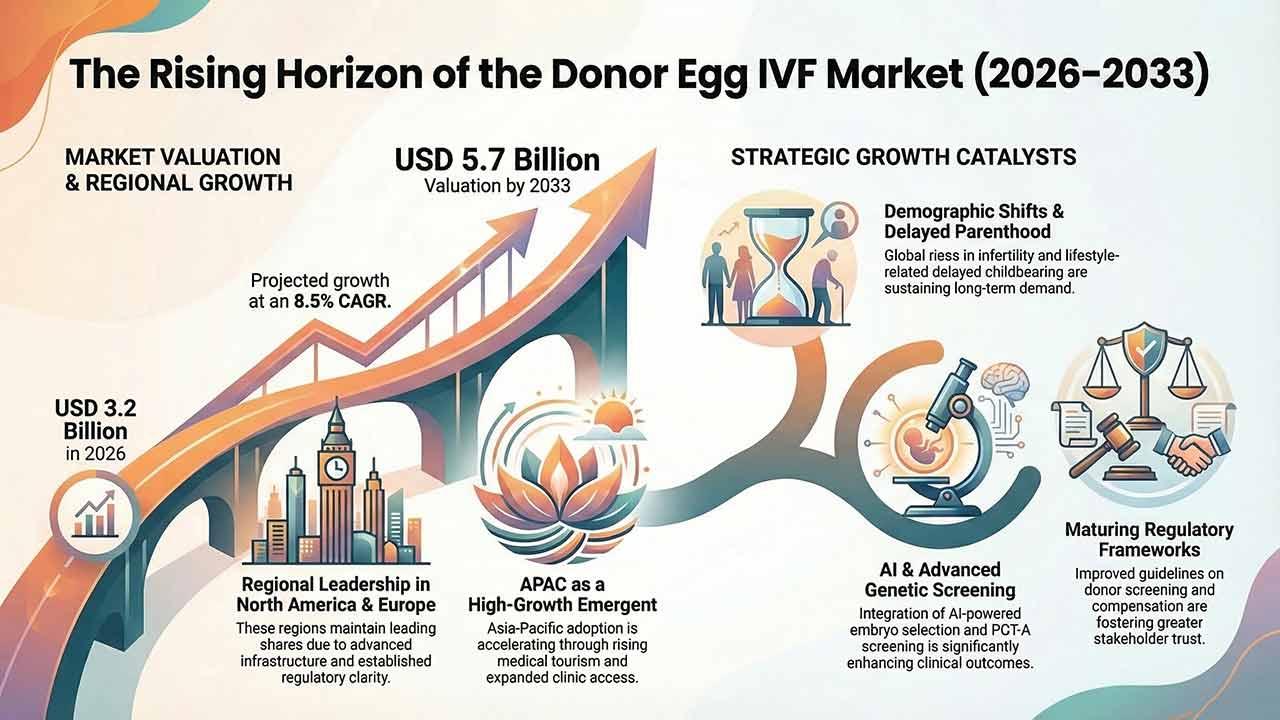
This comprehensive analysis examines the global Donor Egg IVF market, forecasting a valuation of USD 5.7 billion by 2033. The report explores critical growth drivers, including delayed parenthood, technological breakthroughs in embryo selection, and shifting regulatory landscapes, offering a detailed breakdown of market segmentation and regional growth trajectories for the next decade.