Home
 ReportReport
This comprehensive report analyses the Smart Fertility Tracker Market, detailing its projected growth from US$ 160.2 million in 2021 to US$ 428.2 million by 2031. It examines key drivers such as rising infertility and technological advancements in AI-integrated hormone monitoring, alongside detailed segmentation by utility, application, and region.



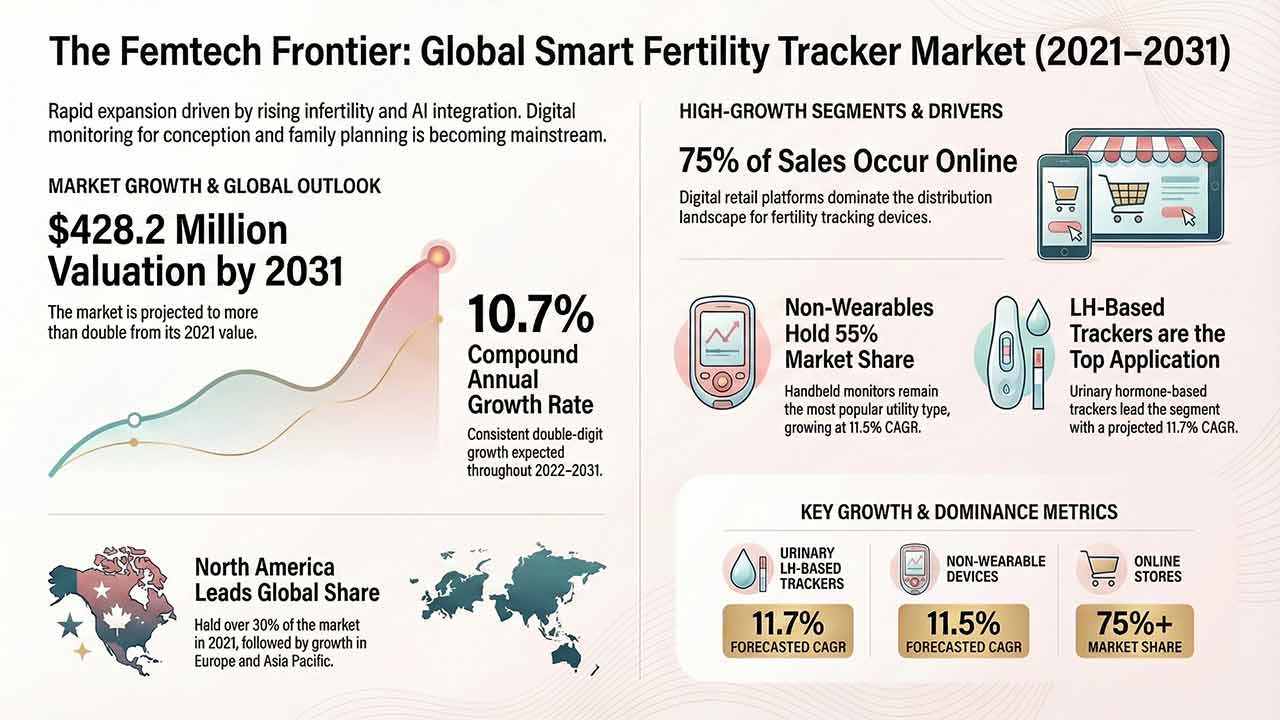
The global landscape of reproductive healthcare is undergoing a significant transformation, driven by the rapid integration of digital technology into personal health management. At the forefront of this shift is the Smart Fertility Tracker Market, a segment that has evolved from niche wearable gadgets to essential medical-grade diagnostic tools. In 2021, the market was valued at US$ 160.2 million, reflecting a burgeoning awareness of reproductive health and the increasing reliability of digital monitoring. As technological innovations continue to converge with healthcare needs, the market is poised for robust expansion, with projections indicating a valuation of US$ 428.2 million by 2031. This growth represents a compound annual growth rate (CAGR) of 10.7% over the forecast period of 2022 to 2031.
Smart fertility trackers are defined as advanced digital devices designed to assist users in tracking ovulation cycles and identifying fertile windows with high precision. Unlike traditional methods that often rely on manual logging and subjective interpretation, these smart devices automate data collection and analysis. They monitor a diverse array of physiological and hormonal indicators, including basal body temperature (BBT), pulse rate, breathing rate, heart rate variability (HRV), sleep patterns, and specific hormone levels found in urine. By integrating mobile applications and connected hardware, the Smart Fertility Tracker Market provides real-time insights and predictive analytics that significantly improve the accuracy of conception planning or natural family planning.
Several socio-economic and health-related factors are accelerating the adoption of these technologies worldwide.
A primary catalyst for market growth is the increasing incidence of infertility affecting both men and women globally. Modern lifestyle changes, high stress levels, obesity, and environmental factors have contributed to a decline in natural fertility rates. As infertility becomes a more prevalent health concern, more individuals are turning to digital monitoring to better understand their reproductive health and optimise their chances of conception.
Conditions such as Polycystic Syndrome (PCOS) are major drivers for accurate tracking solutions. PCOS is one of the most common hormonal disorders among women of reproductive age, often resulting in irregular ovulation cycles that make traditional tracking methods ineffective. Smart fertility trackers offer a solution by providing data-driven ovulation predictions based on physiological indicators, thereby improving outcomes for those with irregular cycles.
There is a growing trend toward fertility awareness methods (FAM) for those seeking natural alternatives to hormonal contraceptives. According to UN data, approximately 7 million unintended pregnancies occur every six months globally, highlighting a critical need for effective tracking tools. Furthermore, the World Health Organization (WHO) noted that the number of women seeking family planning solutions rose from 900 million in 2000 to nearly 1.1 billion by 2020. This shift toward digital reproductive health management is a cornerstone of the Smart Fertility Tracker Market expansion.
The market is categorised by utility, application, distribution channel, and geography, each showing distinct growth trajectories.
In 2021, the non-wearable segment, which includes handheld monitoring devices, dominated the market with a share exceeding 55%. This segment is expected to maintain its lead, growing at a CAGR of 11.5% through 2031. The preference for non-wearables is largely attributed to the popularity of high-precision handheld monitors that offer laboratory-grade results in a home setting.
Based on application, the market includes trackers focused on BBT, urinary luteinising hormone (LH), and electrolyte levels. Currently, the urinary LH-based trackers segment holds the largest market share. This segment is projected to expand at a CAGR of 11.7% during the forecast period due to its superior accuracy in identifying the exact surge that precedes ovulation.
The distribution of these devices is heavily skewed toward online platforms, which accounted for more than 75% of total sales in 2021. The convenience of comparing different models, reading user reviews, and the discreet nature of online shopping have made e-commerce the preferred medium for consumers.
The adoption of fertility technology varies significantly across global regions, influenced by healthcare infrastructure and consumer awareness.
The future of the Smart Fertility Tracker Market is closely tied to advancements in data science and sensor technology.

Despite the optimistic forecast, several hurdles remain that could restrain market growth.
The rapid expansion of the "Femtech" industry has made fertility tracking a lucrative area for investment. Venture capital firms and healthcare investors are increasingly focusing on startups that offer integrated ecosystems, combining hardware devices with sophisticated mobile applications and AI-powered platforms. The projected 10.7% CAGR signals a strong long-term return on investment (ROI) for companies that can successfully navigate regulatory paths and achieve global scale. Investors are particularly attracted to solutions that offer scalable revenue through a combination of device sales and subscription-based digital health services.
The Smart Fertility Tracker Market is set to become a cornerstone of the digital health revolution over the next decade. By bridging the gap between traditional medicine and personal technology, these devices offer women and couples unprecedented control over their reproductive health. While challenges regarding cost and data privacy persist, the overwhelming trend toward proactive, data-driven healthcare suggests that the market will continue its steady climb toward its US$ 428.2 million target by 2031. The ongoing evolution of AI and sensor technology will only further enhance the accuracy and accessibility of these life-changing tools.


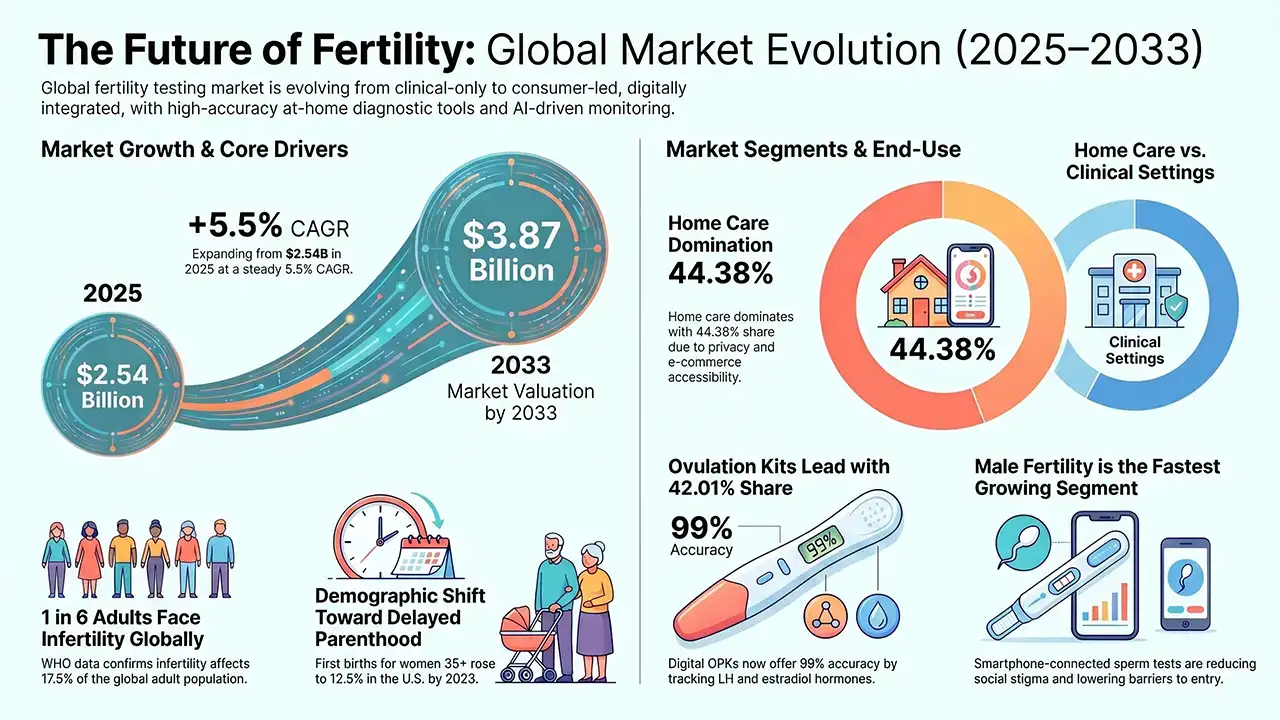
The global Fertility Testing Devices market, valued at USD 2.54 billion in 2025, is projected to reach USD 3.87 billion by 2033, growing at a CAGR of 5.5%. Rising infertility rates, delayed parenthood, and technology-driven at-home testing solutions are fueling robust worldwide demand across North America, Asia Pacific, and beyond.

Researchers at the Babraham Institute and Stanford University have engineered a 3D laboratory model of the human uterus to observe embryo implantation in unprecedented detail, up to day 14 of development. Published in Cell, this breakthrough opens new pathways for understanding IVF failure, miscarriage, and pregnancy complications.

Global fertility tourism is projected to reach US$13,080.0 Mn by 2032 at a 30.3% CAGR, led by IVF and a strong North America share.
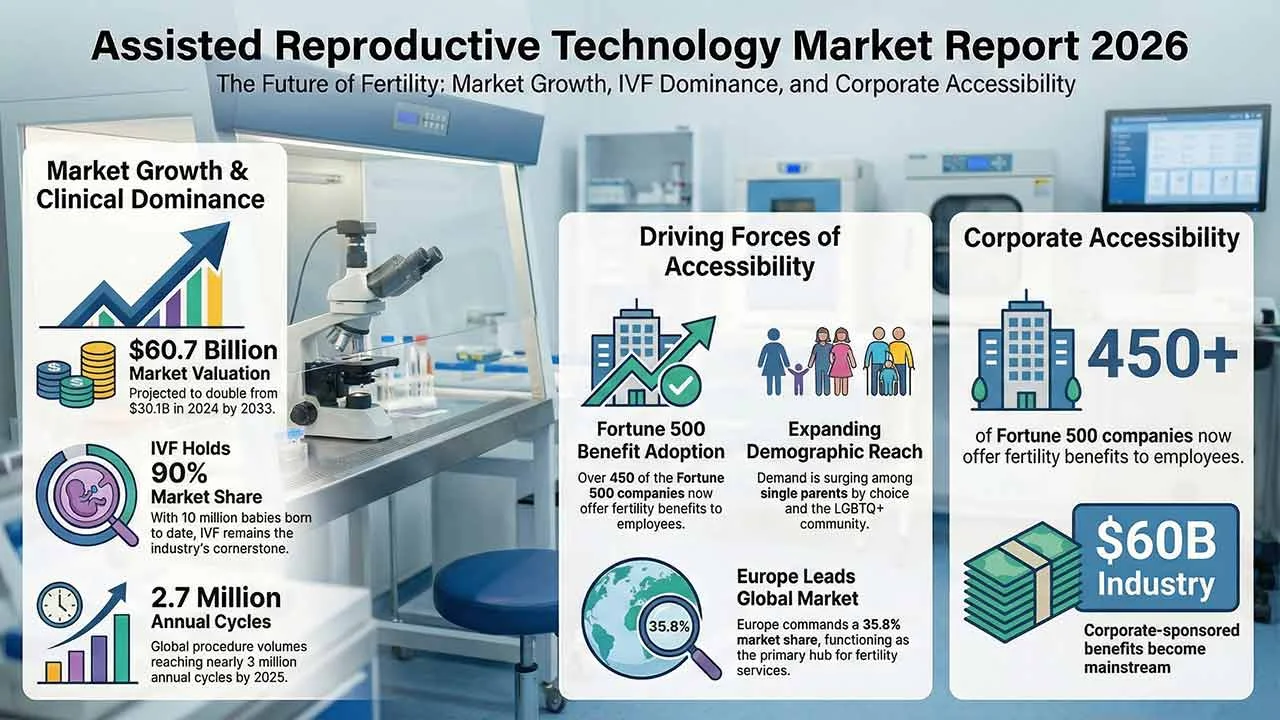
The assisted reproductive technology market continues to expand as infertility rates rise and parenthood is increasingly delayed worldwide. Valued at US$30.1 billion in 2024, the market is projected to reach US$60.7 billion by 2033, supported by IVF innovation, growing awareness, improved accessibility, and sustained investment in reproductive healthcare infrastructure globally.

The global human reproductive technology market is set to reach 45.4 USD billion by 2035, expanding from 27.7 USD billion in 2024 at a 4.6% CAGR. Growth is fueled by technological advancements in fertility treatments, rising infertility rates, delayed pregnancies, and increasing acceptance of single and LGBTQ+ parenting worldwide.

The Sperm Separation Systems Market is projected to exceed USD 1.5 billion by 2035, driven by automation, microfluidics, and rising male infertility awareness.