Home
 ReportReport
The University of Aberdeen has launched a redesigned, free IVF success calculator, the OPIS tool, powered by updated national HFEA data. Built with patients at its centre, the IVF success calculator provides tailored success estimates across up to six IVF or ICSI cycles, helping couples plan emotionally, physically, and financially.




Every year, millions of people around the world begin IVF treatment carrying a question they often cannot get a clear answer to: what are my actual chances? Success rates vary enormously from patient to patient, clinic to clinic, and cycle to cycle, yet the tools available to help patients navigate that uncertainty have historically been built for statisticians, not for the people sitting in waiting rooms. The University of Aberdeen has set out to change that, launching a completely redesigned, free IVF success calculator that puts the patient experience first.
The new tool, publicly available and free to use, draws on data collected from every licensed fertility treatment conducted across the UK. Using that national dataset, it translates complex statistical patterns into tailored success estimates built around a patient's specific circumstances: their age, their infertility diagnosis, and where they are in their treatment journey.
The roots of this calculator stretch back a decade. The first version was launched in 2016, conceived originally as a statistical model and designed primarily as a scientific instrument. It was not built with the patient journey in mind. Despite that, it quickly found an audience: more than 2,500 people around the world used it every month, a figure that spoke loudly to the demand for clear, evidence-based information about IVF success rates that patients could actually understand and act on.
That level of uptake made a compelling case and a clear obligation for something better.
Dr. David McLernon, Senior Research Fellow in Medical Statistics at the University of Aberdeen who leads the project, explained the motivation behind the redesign: "Fertility treatment costs thousands of pounds and could involve months or years of uncertainty, making realistic success estimates crucial for planning. Our calculator, first launched in 2016, was an important step in turning years of national IVF data into a practical tool to help those on this difficult journey, but although we were proud to be able to open our original calculator up to the public, it had its limitations – most notably that it was never created with the patient journey in mind."
The new iteration of the IVF success calculator was not simply updated, it was entirely reconceived. The medical statisticians behind the research partnered with postgraduate students from the University's Aberdeen Software Factory, operated through the School of Natural and Computing Sciences, to carry out the rebuild. Rather than relying on assumptions about what patients needed, the team went directly to the source: they analysed detailed user feedback and conducted intensive sessions with volunteers currently undergoing fertility treatment, recruited with the help of the Fertility Alliance charity.
These "think-aloud" user sessions, in which participants narrated their experience using the tool in real time, combined with an inbuilt OPIS feedback questionnaire, allowed the team to identify precisely where the original calculator fell short and what a genuinely useful tool would look like in practice.
Dr. Milan Markovic, who leads the Aberdeen Software Factory, described the process: "Our students have taken extensive feedback and insights from the inbuilt OPIS feedback questionnaire and 'think‑aloud' user sessions to completely re‑engineer the original IVF calculator. This is hugely valuable for students as they gain experience of developing user-driven products. The result is a tool that is more functional, easier to navigate and far clearer in how it presents results."
The redesigned IVF success calculator now offers three distinct pathways, each calibrated to where a patient is in their fertility journey. The first pathway is designed for people who have not yet started treatment. The second is for those who have already had their first embryo transfer. The third is for couples who have completed a full round of treatment and are deciding whether to begin another.
This structure allows the tool to generate significantly more tailored results, accounting for a broader range of patients and treatments. factors. It also reflects major shifts in IVF practice and policy that have taken place since the original model was built, as well as demographic changes, including the reality that more people are starting fertility treatment later in life than was typical a decade ago.
Critically, just as the original version did, the new calculator shows how success rates evolve across multiple cycles rather than presenting a single-cycle snapshot. This cumulative view has always been one of the tool's most clinically meaningful features. Dr. McLernon elaborated: "One of the most difficult aspects of IVF is understanding how long or costly the process might be. Our calculator can show couples the cumulative chances of success for between one and six rounds of IVF."
Both IVF (in vitro fertilisation) and ICSI (intracytoplasmic sperm injection) cycles are now covered by the tool, and the navigation between sections has been substantially simplified. For couples who are weighing whether to continue treatment, a decision that carries enormous emotional and financial weight – being able to see clearly how their cumulative odds shift with each additional round is among the most practically useful things the calculator can provide.
Underpinning the new IVF success calculator is a substantial and authoritative dataset. The data powering the calculator has been updated with an additional six years of data collected from the Human Fertilisation and Embryology Authority (HFEA), compiled from all licensed fertility treatments in the UK. This update extends the evidence base considerably beyond the original model, which drew on treatment cycles from 1999 to 2008. In 2023, 18,520 opposite-sex couples using their own eggs and sperm started their first IVF treatment in the UK, an indication of the scale of need that tools like this are designed to serve.
The HFEA data represents a uniquely comprehensive national resource, capturing outcomes from every licensed fertility clinic in the country rather than a sample. For a prediction tool, this breadth is not incidental, it is what gives the estimates their statistical credibility.
Fertility treatment is rarely just a medical decision. For most couples, it sits at the intersection of profound personal hope, significant financial pressure, and grinding emotional uncertainty. Cycles can cost thousands of pounds each, and many couples go through multiple rounds with no guarantee of success. The ability to go into that process with a clearer, evidence-grounded understanding of what is realistic – not just optimistic – has real practical value.
Dr. McLernon addressed this directly: "Having a better understanding of their chances of success helps people to prepare emotionally and financially for the potentially difficult journey on which they are about to embark. Our first calculator delivered solid statistical results, but this new version brings those insights into a platform that's clearer, more intuitive and genuinely built for patients." That combination, solid statistical foundations made accessible through thoughtful design, is what distinguishes this version of the IVF success calculator from its predecessor and from much of what is currently available to patients online.
One of the less obvious but genuinely significant aspects of this project is who built it. The Aberdeen Software Factory model, in which postgraduate computing students work on real-world problems rather than simulated assignments, produced a finished product that will be used by thousands of people navigating one of the most difficult experiences of their lives. For the students involved, the project offered something that coursework alone cannot: the experience of designing for genuine user need under real constraints, with outcomes that matter.
The collaboration between medical statisticians and computing students – brought together under the umbrella of a research university – produced a tool that neither group would likely have developed as effectively alone. The statisticians brought the evidential rigour; the students brought the UX sensibility that the original version lacked.
For couples currently in or considering IVF treatment, the redesigned tool offers a starting point that is better than most of what has previously been available: free, grounded in comprehensive national data, and built around the actual questions that patients are asking. It will not eliminate uncertainty – no calculator can – but it can help set realistic expectations, which research consistently suggests improves decision-making and psychological preparedness during what is often an exceptionally difficult process. The calculator is available free of charge at opis.asf.abdn.ac.uk. For the researchers at the University of Aberdeen, the launch marks not an endpoint but a continued commitment to translating rigorous fertility science into tools that the people who need them most can actually use.


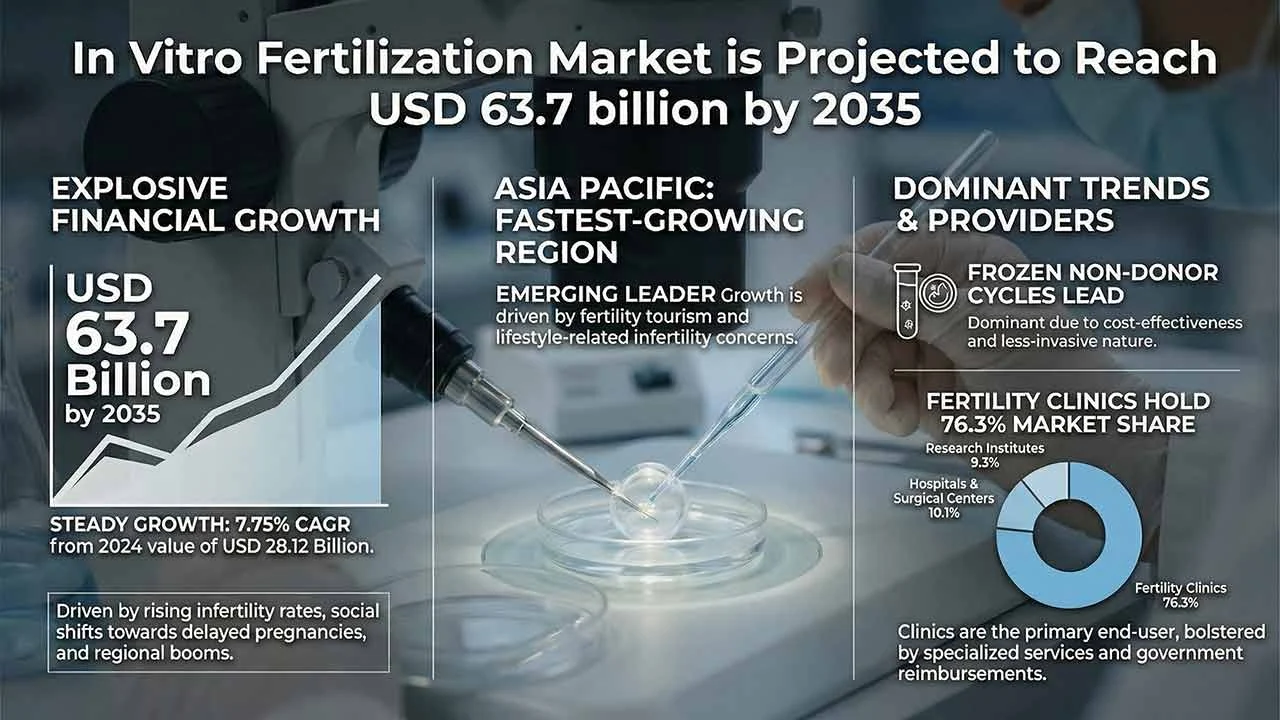
In Vitro Fertilization (IVF) market is expanding rapidly, driven by rising infertility, delayed pregnancies, and advances in IVF technology. Valued at USD 28.12 billion in 2024, the market is projected to reach USD 63.7 billion by 2035, supported by frozen cycles, fertility tourism, and innovation-led clinic growth worldwide.

Microfluidic automation IVF with the FIND-Chip is transforming fertility care by recovering eggs previously discarded during manual screening. Clinical trials show improved embryo yield and a successful live birth from retrieved eggs. The automated system reduces human error, supports satellite clinics, and expands global access to IVF treatment.

Global Preimplantation genetic testing market outlook covering growth drivers, segmentation, regional trends, key technologies, restraints, opportunities, and competitive landscape approaching $1B by 2032.
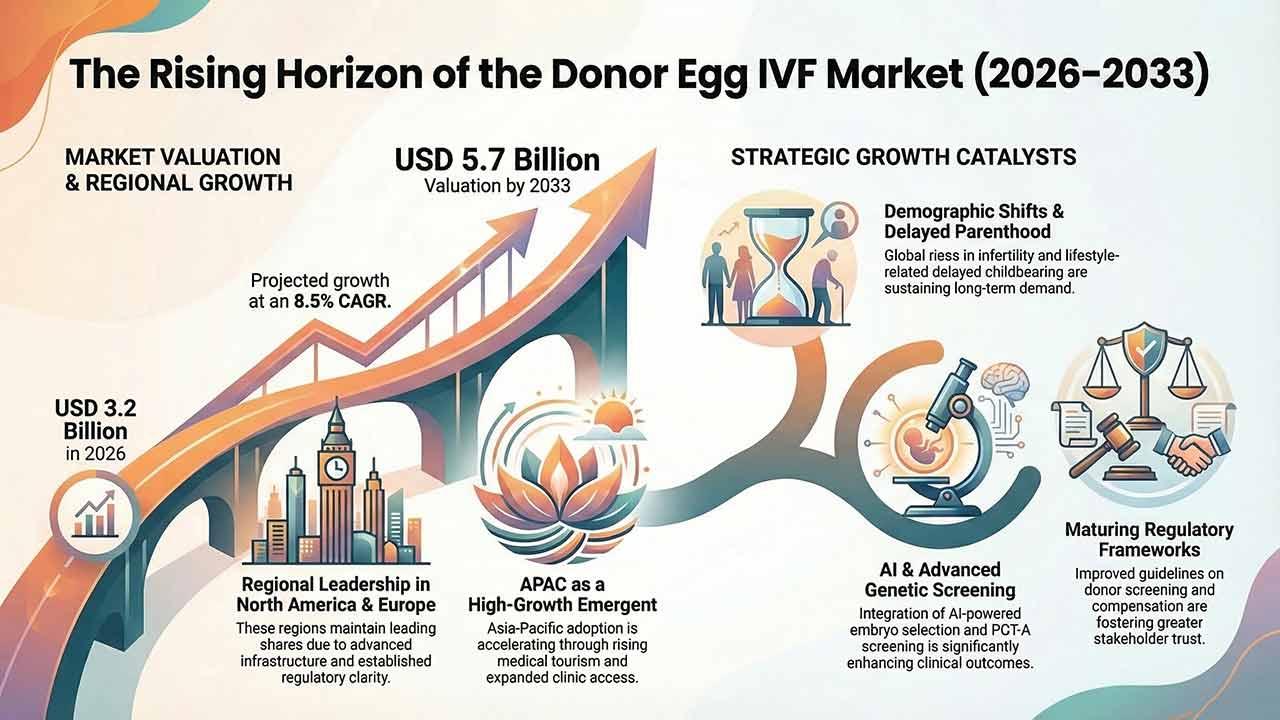
This comprehensive analysis examines the global Donor Egg IVF market, forecasting a valuation of USD 5.7 billion by 2033. The report explores critical growth drivers, including delayed parenthood, technological breakthroughs in embryo selection, and shifting regulatory landscapes, offering a detailed breakdown of market segmentation and regional growth trajectories for the next decade.
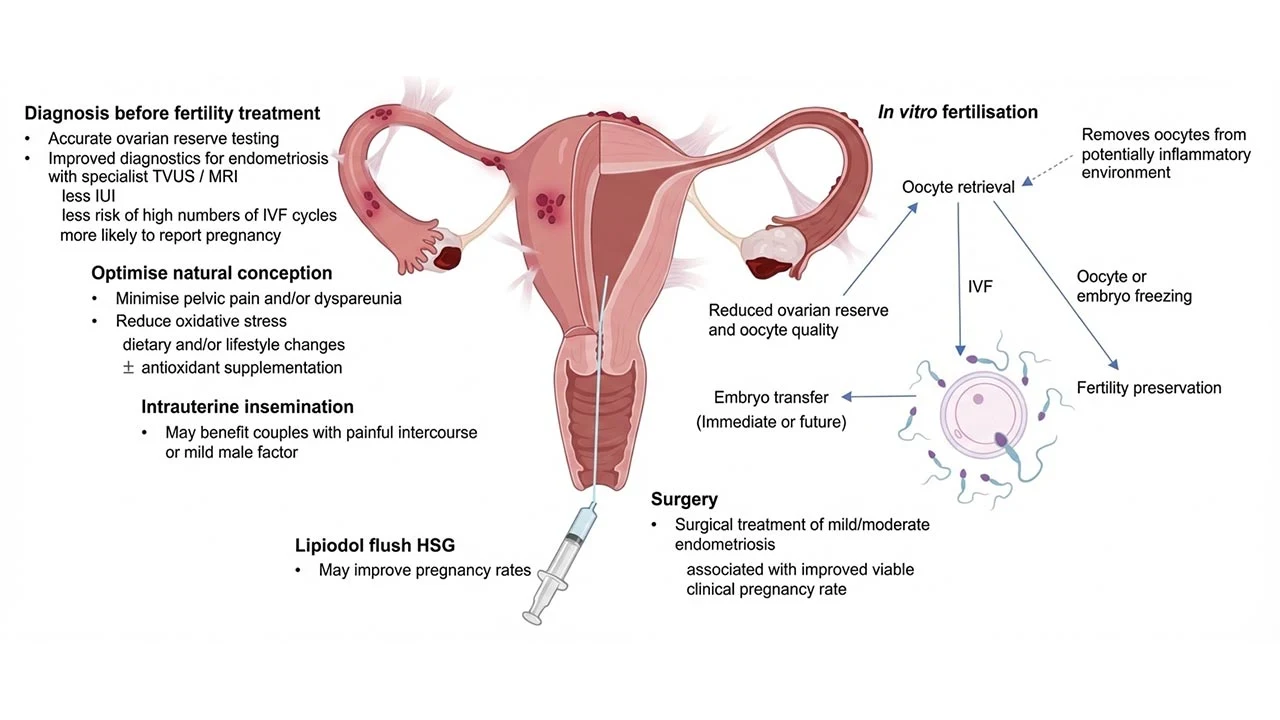
Integrating IVF and Surgical Management in Endometriosis offers a patient-centered strategy to improve fertility while managing chronic pain. By integrating laparoscopic surgery, ovarian reserve assessment, and assisted reproductive technology, clinicians can tailor treatment plans, enhance live birth rates, and optimize reproductive outcomes for women facing complex endometriosis-related infertility challenges.
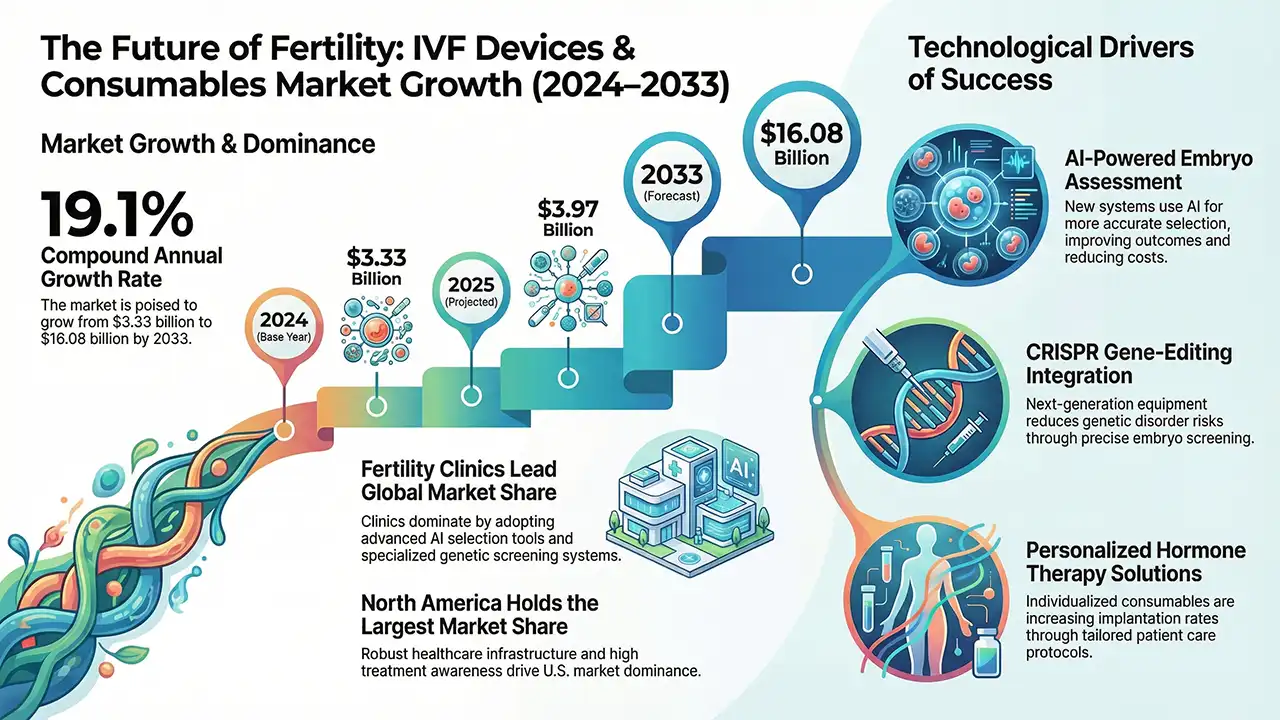
The global IVF Devices and Consumables market is projecting a significant surge to $16.08 billion by 2033. Driven by rising infertility and tech innovations, the analysis covers regional shifts, product segments, and emerging trends, highlighting the industry’s evolution alongside the growing Smart Fertility Tracker Market
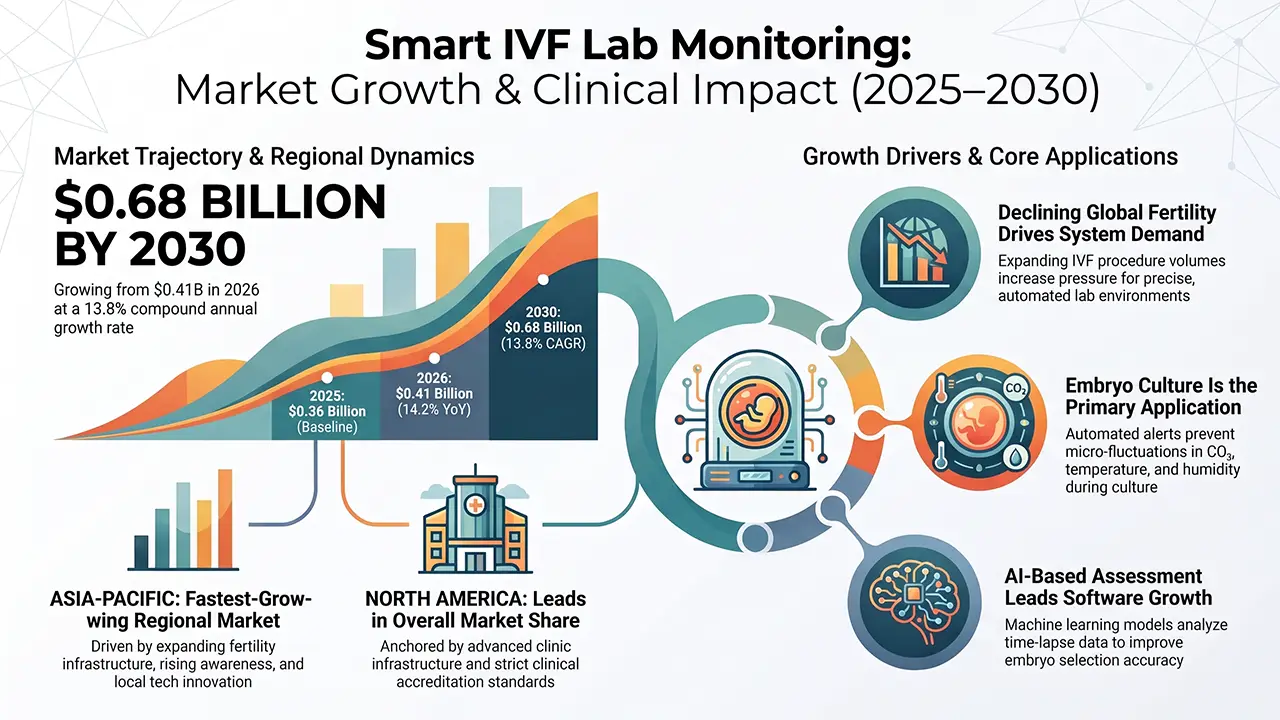
The global smart IVF lab monitoring market, valued at USD 0.41 billion in 2026, is projected to reach USD 0.68 billion by 2030 at a 13.8% CAGR. Rising infertility rates, growing adoption of real-time lab automation, and AI-driven monitoring platforms are fueling strong global demand across North America and Asia-Pacific.