Home
 ReportReport
The global egg freezing and embryo banking industry is expanding rapidly, projected to reach USD 13.6 billion by 2035. Rising infertility rates, vitrification breakthroughs, automation in cryopreservation, and increasing acceptance of delayed parenthood are reshaping global reproductive healthcare markets, with North America leading and Asia-Pacific emerging strongly.



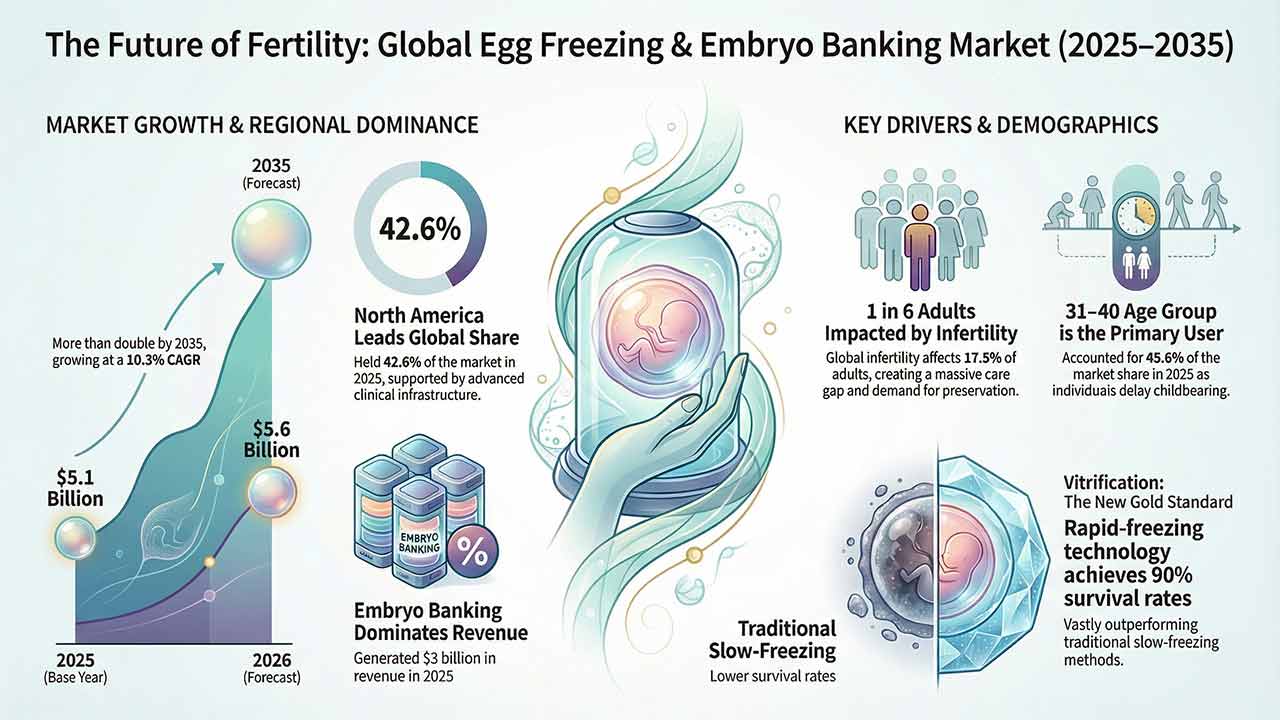
The global landscape for reproductive health is undergoing a transformative shift, characterized by a rapid increase in the demand for fertility preservation services. In 2025, the global market for these services was valued at USD 5.1 billion. This sector is projected to experience robust growth, climbing from USD 5.6 billion in 2026 to USD 13.6 billion by 2035, representing a compound annual growth rate (CAGR) of 10.3%. This expansion is primarily fueled by a convergence of factors: rising global infertility rates, significant advancements in cryopreservation technology, and a growing societal acceptance of delayed parenthood. As more individuals and couples seek proactive measures to manage their biological clocks, the egg freezing and embryo banking industry has emerged as a critical pillar of modern personalized reproductive care.
A pivotal driver for market demand is the alarming rise in global infertility rates. According to the World Health Organization (2023), infertility impacts approximately 17.5% of the adult population worldwide, which equates to roughly one in six individuals. This prevalence is remarkably consistent across different income levels, affecting 17.8% of people in high-income countries and 16.5% in low- and middle-income nations. With an estimated 42 to 180 million people globally struggling with infertility, there is a substantial care gap that egg freezing and embryo storage services are increasingly filling.
Furthermore, the rapid expansion of specialized fertility clinics is significantly improving global access to these services. In the United States alone, the CDC reported 457 fertility clinics in 2022, which performed over 184,000 egg and embryo-banking cycles. Strategic partnerships between clinics, insurance providers, and employers are also playing a crucial role in reducing financial barriers. Many employers now offer assistance with these procedures as part of their employee benefits packages, normalizing fertility preservation as a standard component of reproductive healthcare.
However, the market faces notable challenges. The high cost associated with these procedures remains a primary barrier, limiting affordability for a large segment of the global population. Additionally, ethical and legal complexities regarding the long-term disposition and use of frozen genetic material continue to raise regulatory hurdles and patient concerns in various jurisdictions.
The market is bifurcated into two primary service types: egg freezing (oocyte cryopreservation) and embryo banking.
Technological breakthroughs have been fundamental to the growth of the egg freezing and embryo banking industry, specifically the transition from slow-freezing methods to vitrification. Vitrification is an ultra-rapid cryopreservation technique that cools eggs and embryos into a glass-like state, effectively preventing the formation of damaging ice crystals. This technology boasts a post-thaw survival rate of 92% to 97% for oocytes, a stark contrast to the approximately 30% survival rate seen with traditional slow-freezing. Consequently, the vitrification segment is expected to grow at a 10.4% CAGR.
Innovations are also occurring in automation and chemical media. Automated vitrification platforms, such as Overture Life’s DaVitri system, are standardizing procedures and reducing the risk of human error in clinics. Furthermore, advancements in cryoprotectants, using agents like ethylene glycol and DMSO combined with non-permeating agents like trehalose, have significantly improved cell viability and implantation rates. These improvements support higher success rates in IVF cycles and reinforce the reliability of long-term storage.
The market serves several critical applications, with fertility preservation being a major segment, accounting for 30.8% of the market share in 2025. This segment is driven by a global decline in fertility rates; the global average fell from 3.31 live births per woman in 1990 to 2.25 in 2024. Beyond elective preservation for lifestyle reasons, oncofertility is a vital application, allowing cancer patients to preserve their reproductive options before undergoing gonadotoxic treatments. Other segments include donor egg/embryo programs and genetic screening.
Demographically, the 31 to 40 age group is the most significant, holding a 45.6% market share in 2025. This demographic is critical because reproductive potential begins to decline more rapidly after age 30, making it the primary window for individuals seeking to mitigate age-related fertility loss. According to the Global Burden of Disease Study 2021, infertility affects roughly 3.7% of women aged 15-49 globally, with risks accelerating significantly for those in their 30s.

The egg freezing and embryo banking industry exhibits distinct regional trends, with North America leading and Asia-Pacific emerging as the fastest-growing region.
The market is aiming for increased efficiency and success rates in the future. Continued innovation in vitrification and the adoption of AI-driven selection are expected to reduce procedural risks and make fertility preservation more reliable than ever. As disposable incomes rise in emerging economies like India, Brazil, and South Africa, new growth opportunities will continue to emerge. The expansion of insurance coverage will also be a critical factor in accelerating utilization by reducing the financial burden on patients. By 2035, the egg freezing and embryo banking industry is set to become a USD 13.6 billion global enterprise, reflecting its essential role in addressing the global infertility crisis and the modern desire for reproductive autonomy


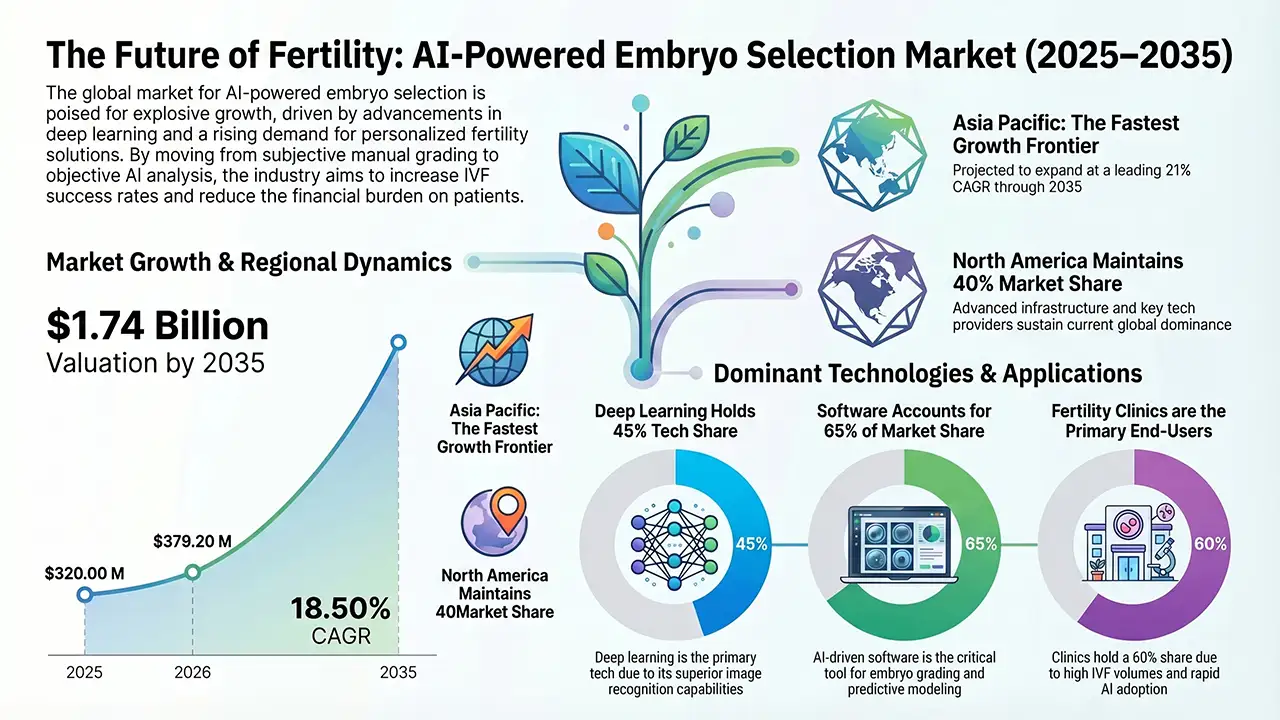
The global AI-Powered Embryo Selection industry, forecasting substantial growth from 2026 to 2035. It details technological shifts in deep learning, regional market dominance in North America, and the accelerating demand for personalized fertility solutions, providing a data-driven outlook on the future of reproductive medicine.
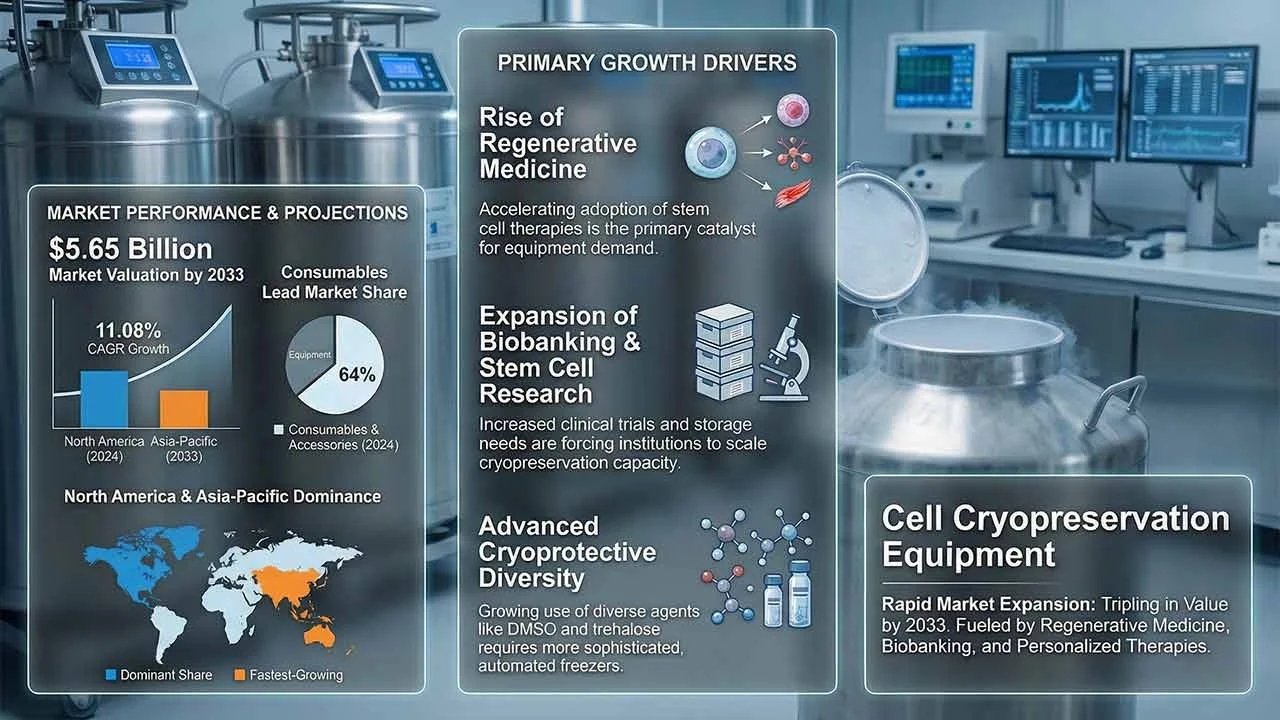
Cell cryopreservation equipment market is witnessing strong growth, supported by rising adoption in regenerative medicine, stem cell banking, and biobanking. Valued at USD 2.20 billion in 2024, the market is projected to reach USD 5.65 billion by 2033, driven by automation, consumables demand, and expanding cell-based therapy pipelines worldwide.