Home
 ReportReport
The surrogacy tourism market is projected to reach USD 31.5 billion by 2035, fueled by rising infertility, evolving legal frameworks, and technological integration. Cross-border demand, AI-powered matching, blockchain contracts, and expanding access in Latin America and Eastern Europe are reshaping global family-building pathways.



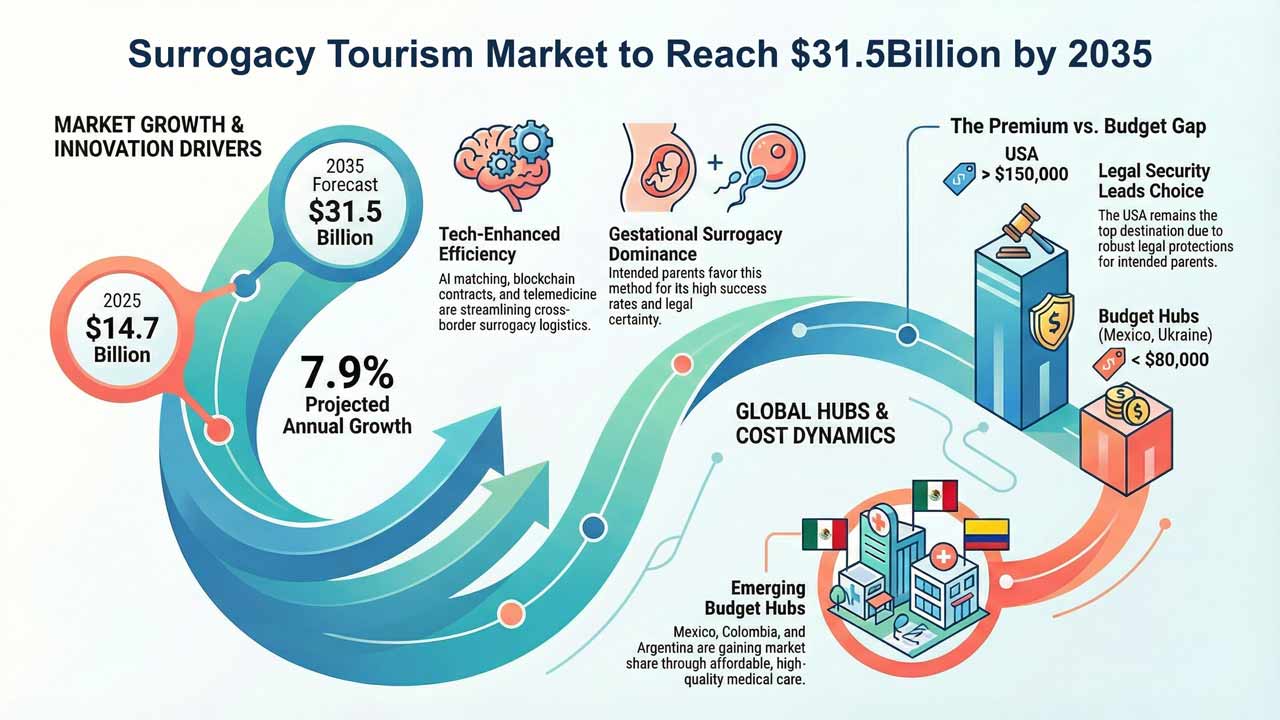
The surrogacy tourism market is currently undergoing a period of robust expansion as intended parents increasingly seek cross-border solutions for family building. In 2024, the industry reached a valuation of USD 13.6 billion. As of 2025, the market was valued at USD 14.7 billion and is projected to reach USD 31.5 billion by 2035. This growth represents a steady compound annual growth rate (CAGR) of 7.9% over the ten-year forecast period.
This upward trajectory follows a historical growth phase between 2020 and 2024, during which the industry expanded at a CAGR of 6.8%. The acceleration in growth is primarily attributed to rising global infertility rates, a shift in legal landscapes across various nations, and the increasing adoption of advanced assisted reproductive technologies (ART). Furthermore, as social norms evolve, there is a heightened demand from non-traditional family units, including LGBTQ+ individuals and single parents, who often require international services due to restrictive laws in their home countries.
Several fundamental factors are propelling the surrogacy tourism market toward its multi-billion-dollar future:
Technology is fundamentally transforming the surrogacy tourism market by increasing efficiency, transparency, and medical success rates.

Gestational surrogacy remains the dominant segment within the market. This is largely due to its superior legal certainty compared to traditional surrogacy. In gestational arrangements, the surrogate is not genetically related to the child, which simplifies the process of establishing parental rights and avoids many of the legal complications associated with traditional surrogacy. The United States, particularly states like California, Illinois, and Connecticut, is considered the safest and most advanced destination for this service.
Intended parents are the most significant end-user segment, as their preferences for medical quality, ethical standards, and legal security define industry trends. Wealthy individuals and celebrities often gravitate toward high-cost, high-certainty markets like California. Meanwhile, LGBTQ+ couples represent a rapidly growing demographic, specifically seeking progressive jurisdictions like Canada and Colombia, where their parental rights are legally recognised.
While many parents still rely on established agencies like Circle Surrogacy and Growing Generations for full medical, legal, and logistical support, online platforms are gaining ground. Companies like SurrogacyMap and MySurrogateMatch use AI to facilitate direct or semi-direct matches, offering more flexibility to tech-savvy parents.
The United States is the undisputed global leader in the surrogacy industry. States such as California, Illinois, and Florida provide a robust legal framework that includes pre-birth orders, ensuring intended parents are recognised as the legal parents before the child is even born. Although costs are high, ranging from USD 120,000 to USD 180,000, the high success rates and strict medical regulations make it the preferred choice for those who can afford it. It is a primary destination for clients from countries with surrogacy bans, such as France and Germany.
Ukraine has historically been a major European hub due to its well-defined laws and affordability. Surrogacy in Ukraine typically costs between USD 40,000 and USD 60,000, attracting parents from Western Europe and China. However, current geopolitical tensions have introduced significant uncertainty, leading some agencies to relocate operations and causing intended parents to look toward alternative markets like Georgia.
Latin America is emerging as a critical region for budget-conscious and LGBTQ+ intended parents.
As the industry grows, so does the focus on ethical surrogacy. Leading agencies are increasingly implementing surrogate welfare programs to ensure medical and emotional support for surrogates. Regulatory changes in former hubs like India and Thailand have shifted the market toward new destinations that can provide both legal clarity and ethical safeguards. In September 2024, the Mexican government announced new regulatory frameworks designed to protect surrogacy arrangements in specific states, signalling a move toward more structured and transparent industry standards.
The surrogacy tourism market is set for a decade of rapid transformation. Intended parents will likely continue to prioritise destinations that offer a balance of legal security, medical excellence, and affordability. The integration of AI and blockchain will become standard practice to mitigate risks in cross-border transactions. While high-cost destinations like the United States will maintain their status due to legal reliability, the most significant growth may occur in Latin American and Eastern European hubs that can successfully navigate the complexities of international law and ethical treatment. By 2035, the market’s expected USD 31.5 billion valuation will reflect a highly globalised and technologically advanced landscape dedicated to meeting the diverse needs of the global parenting community.


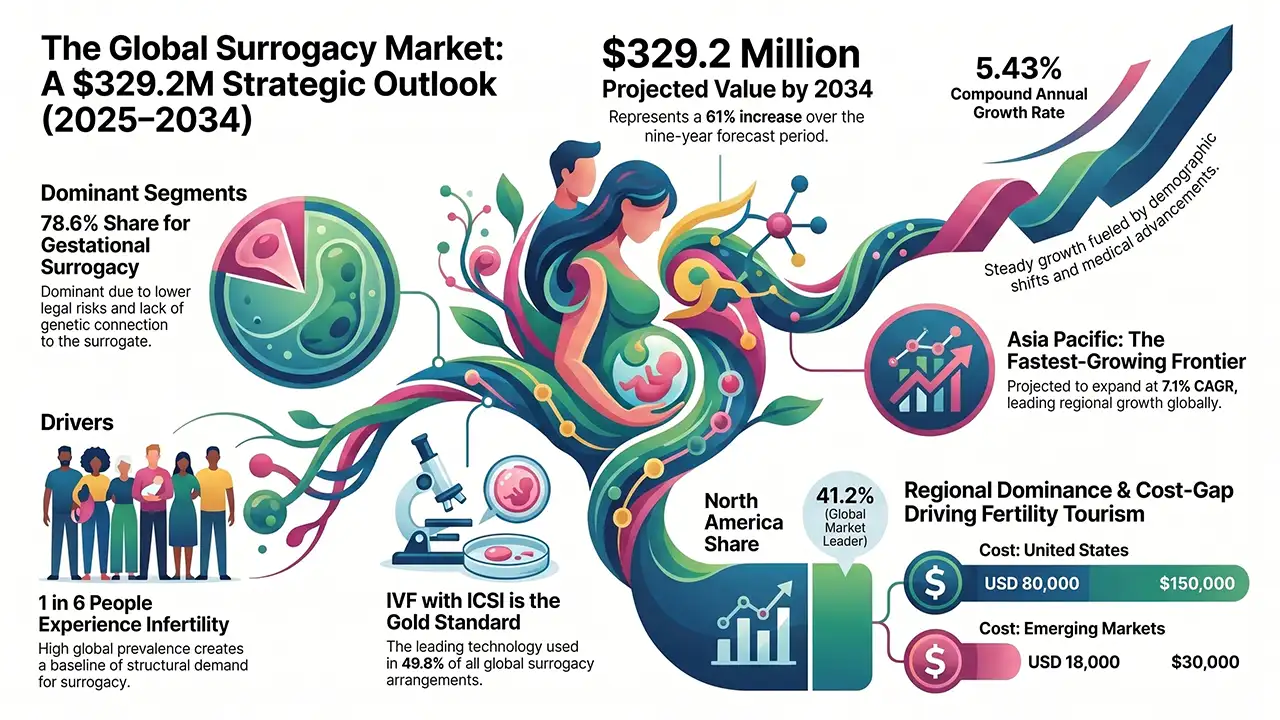
The global surrogacy market, valued at USD 204.6 million in 2025, is projected to reach USD 329.2 million by 2034 at a CAGR of 5.43%. Rising infertility rates, expanding LGBTQ+ family-building demand, and advancements in IVF technology are driving sustained growth across North America, Europe, and the Asia Pacific region.