Home
 ReportReport
The global AI-Powered Embryo Selection industry, forecasting substantial growth from 2026 to 2035. It details technological shifts in deep learning, regional market dominance in North America, and the accelerating demand for personalized fertility solutions, providing a data-driven outlook on the future of reproductive medicine.



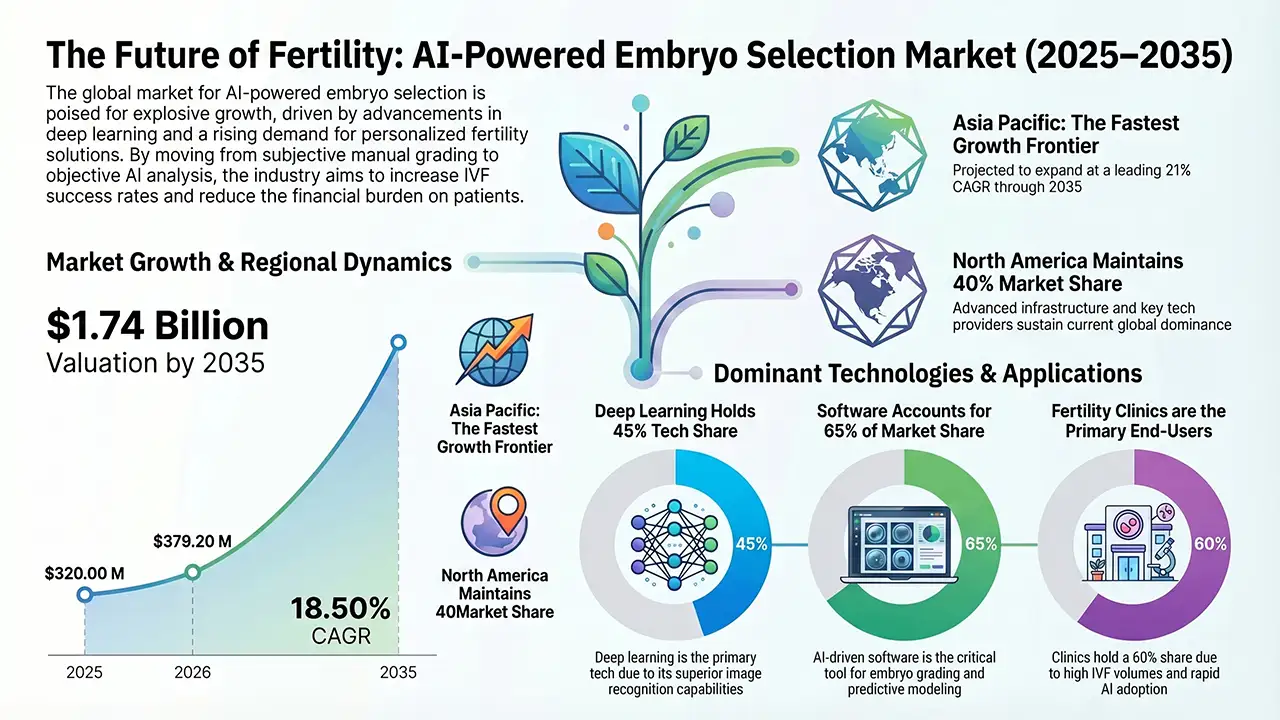
The landscape of reproductive medicine is undergoing a profound transformation as artificial intelligence and machine learning technologies redefine traditional approaches to infertility treatment. The global AI-Powered Embryo Selection market, valued at USD 320.00 million in 2025, is poised for an era of rapid expansion. It is projected to grow from USD 379.20 million in 2026 to approximately USD 1,747.16 million by 2035, representing a robust compound annual growth rate (CAGR) of 18.50% over the forecast period. This growth is primarily fueled by continuous advancements in computational algorithms, rising success rates in assisted reproductive technology (ART), and a global shift toward personalized healthcare solutions.
The integration of AI-driven selection processes allows embryologists to evaluate embryo viability with a level of precision and objectivity previously unattainable through conventional techniques. By analyzing massive datasets involving developmental patterns and morphological features, these systems identify subtle characteristics that indicate higher implantation potential. This technology not only standardizes clinical decision-making but also aims to reduce the significant emotional and financial burdens placed on patients by minimizing the number of IVF cycles required to achieve a successful pregnancy.
The primary catalyst for this market is the increasing adoption of AI-driven IVF tools within clinical settings. As fertility centers strive to optimize outcomes, AI algorithms that process genetic, clinical, and morphological factors are becoming indispensable. Furthermore, the demand for personalized fertility treatment represents a significant opportunity. By tailoring embryo selection to the specific clinical profile of an individual patient, these technologies offer a pathway to higher efficiency and reduced risks during the implantation phase.
Moreover, the market is benefiting from the growing integration of AI-enabled telehealth. These digital platforms facilitate remote consultations and seamless data sharing between clinics and technology providers, thereby increasing the accessibility of advanced fertility care in diverse geographic regions.
Despite the optimistic growth trajectory, the industry faces hurdles related to ethical concerns and limited data transparency. The use of complex algorithms in reproductive health raises questions regarding the reliability of AI models and the handling of sensitive patient data. Some healthcare providers and patients remain hesitant due to a lack of transparency in how these models arrive at their conclusions, which may hinder widespread adoption if not addressed through clearer regulatory frameworks and improved data disclosure.
The market is categorized into software and services, with the software segment holding a dominant position. In 2025, software accounted for 65% of the market share and is expected to grow at the fastest CAGR of 19.0% through 2035. The dominance of this segment is attributed to the critical role that AI-driven software plays in grading embryos, analyzing time-lapse images, and generating predictive models that reduce manual subjectivity.
The services segment, which held a 35% share in 2025, is projected to grow at a CAGR of 17%. The demand for these services—which include system training, AI integration, and continuous technical support—is rising as fertility clinics transition toward digitized, AI-supported infrastructures. These services are essential for ensuring that clinical staff can effectively utilize the complex data outputs generated by the software.
Technologically, the market is led by the deep learning segment, which commanded a 45% share in 2025. Deep learning is anticipated to remain the leading technology, growing at a CAGR of 20.5%. Its ability to analyze raw time-lapse video sequences without preconceived notions allows it to discover developmental markers that human embryologists might overlook.
Machine learning (ML) held a 30% share in 2025, with an expected CAGR of 16.5%. ML is widely utilized for predictive analytics, where it evaluates embryo quality based on historical clinical patterns to prioritize embryos for transfer. Meanwhile, computer vision accounted for 25% of the market in 2025. Growing at a CAGR of 17.5%, computer vision is vital for real-time monitoring and image processing, providing a benchmark that reduces the variability inherent in human observation.
In Vitro Fertilization (IVF) remains the primary application for this technology, accounting for 50% of the market share in 2025. AI improves oocyte quality assessment and helps predict optimal stimulation protocols, which enhances the overall success rate of the IVF process.
The embryo viability assessment segment is identified as the fastest-growing application, with a projected CAGR of 20%. This segment focuses on using digital video data to score embryos shortly before cryopreservation or transfer, a process that significantly minimizes human bias. Genetic screening also holds a significant share at 20%, with a CAGR of 19.5%, as AI becomes increasingly adept at interpreting chromosomal abnormalities to support better outcomes.
In terms of end-use, fertility clinics lead the market with a 60% share as of 2025. These facilities are the early adopters of AI tools due to their high volume of IVF procedures and the direct need for operational efficiency. The hospital segment held 25% of the market, driven by the integration of AI into broader reproductive medicine departments and the move toward interoperable digital health infrastructures. Research institutes accounted for the remaining 15%, focusing on the development and validation of new AI models and drug discovery processes.
North America was the leading regional market in 2025, capturing 40% of the global share. The North American market is estimated to grow from USD 128.00 million in 2025 to USD 707.60 million by 2035, at a CAGR of 18.65%. This dominance is supported by a highly developed healthcare infrastructure and a strong presence of technology providers. Within this region, the United States is the primary contributor, with its market expected to reach USD 534.24 million by 2035.
Europe held the second-largest market share at 30% in 2025. The region is expected to grow at a CAGR of 17.8%, driven by rising infertility rates and supportive medical device regulations. Germany shows steady growth within the European market due to its emphasis on clinical precision and advanced laboratory infrastructure.
The Asia Pacific region is observed to be the fastest-growing market, with a projected CAGR of 21% between 2026 and 2035. In 2025, it held a 20% share of the market. Rapid expansion of IVF clinics and government initiatives supporting digital healthcare are key factors in this region. China leads the Asia Pacific market, benefiting from a robust technology ecosystem and increasing societal acceptance of fertility services.
Several shifts are expected to define the market as it approaches 2035. There is an increasing emergence of patient-centered digital platforms that allow for better tracking of treatment progress and more informed decision-making by both clinicians and patients. Additionally, the industry is seeing a rise in strategic partnerships between AI developers and IVF technology providers to create integrated, data-driven solutions.
Recent developments in 2025, such as the integration of AI into large fertility clinic chains to enhance transparency and the achievement of regulatory certifications for new AI-powered tools in Europe, indicate that the technology is moving from experimental use to standardized clinical practice.
The AI-Powered Embryo Selection market is set for transformative growth over the next decade. By shifting the paradigm from subjective assessment to data-driven precision, these technologies are increasing the efficiency of fertility treatments globally. While ethical and transparency concerns remain to be fully addressed, the clear benefits of higher success rates and personalized care are driving the industry toward its USD 1.7 billion valuation by 2035. As deep learning continues to evolve and emerging markets in the Asia Pacific region expand their fertility infrastructures, the role of artificial intelligence in human reproduction will only become more central to the global healthcare landscape.


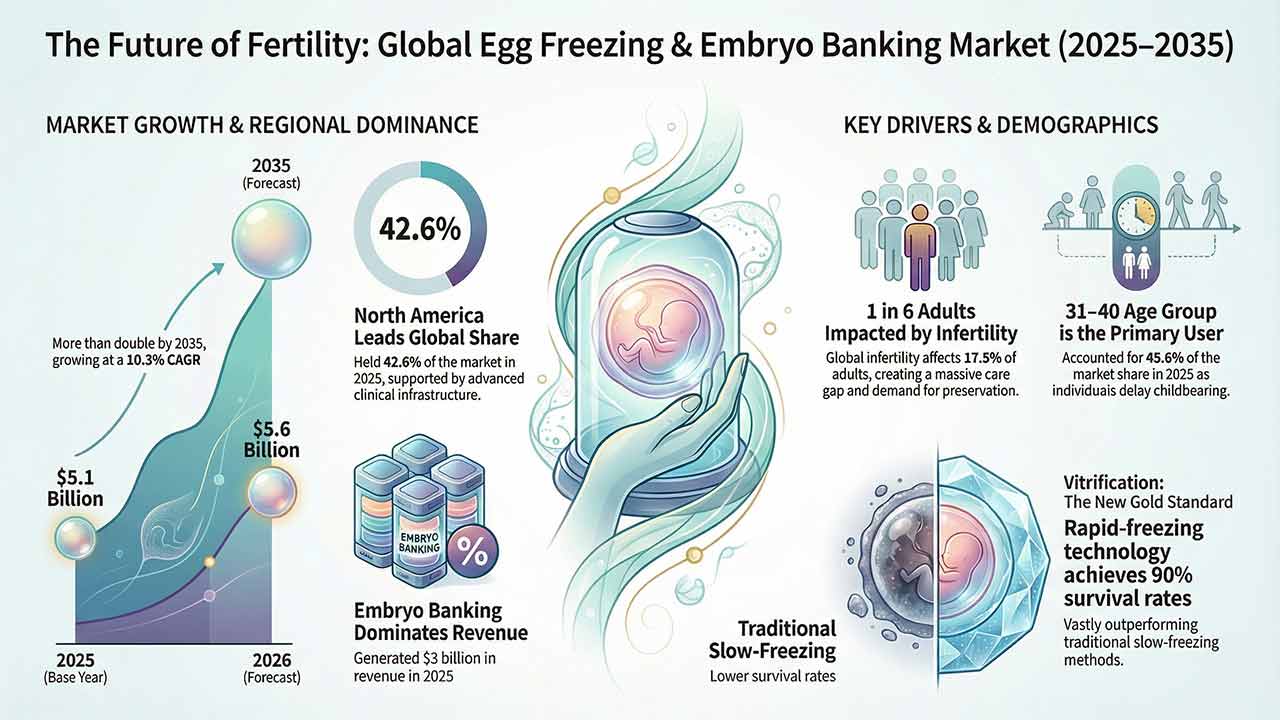
The global egg freezing and embryo banking industry is expanding rapidly, projected to reach USD 13.6 billion by 2035. Rising infertility rates, vitrification breakthroughs, automation in cryopreservation, and increasing acceptance of delayed parenthood are reshaping global reproductive healthcare markets, with North America leading and Asia-Pacific emerging strongly.
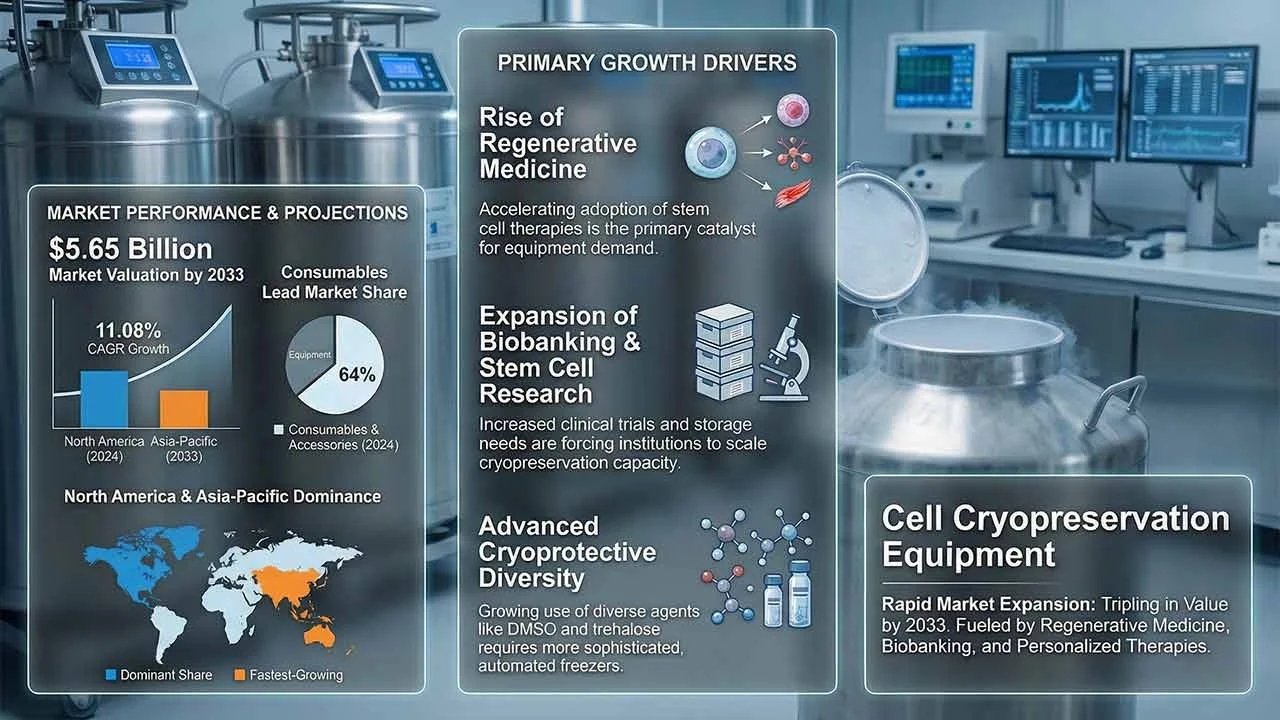
Cell cryopreservation equipment market is witnessing strong growth, supported by rising adoption in regenerative medicine, stem cell banking, and biobanking. Valued at USD 2.20 billion in 2024, the market is projected to reach USD 5.65 billion by 2033, driven by automation, consumables demand, and expanding cell-based therapy pipelines worldwide.