Home
 ReportReport
The Rising Trends of Gamete Preservation Market report delivers a detailed 2025–2032 outlook, combining qualitative and quantitative insights on market size, segmentation, and regional dynamics. It explores key drivers, challenges, and opportunities, highlighting strategic developments and competitive positioning to guide data-driven investment and growth decisions across global markets.




The Rising Trends of Gamete Preservation Market underscores a structured outlook spanning 2025–2032, emphasizing qualitative and quantitative analysis across segments, countries, and regions to define market sizes and future values. The scope includes strategic developments such as agreements, launches, collaborations, and joint ventures that shape competitive positions globally and regionally. The report's goal is to look at revenue by type and use, turning drivers, restraints, and trends into useful information for stakeholders. This framework positions the market as data-driven, methodical, and geared toward practical decision support. In this context, the Rising Trends of Gamete Preservation Market aligns growth narratives with segmental forecasts and regional consumption profiles.

The market overview is framed around defining sizes by segment and country for recent years, then forecasting values through 2025–2032 with an integrated methodology that blends qualitative and quantitative lenses. Influencing factors are grouped into trends, restraints, and drivers, enabling a comprehensive view of how market forces may shift performance across the forecast period.
Market share volatility represents a core challenge, where rapid shifts in consumer segments can precipitate declines without vigilant monitoring and adaptation. Competitive landscape complexity demands continuous market share analysis covering position, percentage share, and segmented revenue to maintain defensive and offensive strategies. Another restraint is the interplay of drivers and restraints that can transform growth trajectories in either direction, requiring granular, segment-level oversight. These challenges imply that sustained performance hinges on disciplined segmentation, real-time competitive intelligence, and calibration to regional consumption dynamics. The Rising Trends of Gamete Preservation Market frames these constraints as manageable through structured insights and planning.
Opportunities align with the “competitive strategic window,” where targeted investment across products, segments, and applications can capture incremental revenue through 2025–2032. The report highlights technology trends and regulatory frameworks as critical enablers, guiding portfolio alignment and market entry or expansion strategies. Decision-making is further supported by in-depth profiling of stakeholders and comprehensive regional analysis, illuminating fit-for-purpose plays across institutional and consumer-facing demand. As such, the Rising Trends of the Gamete Preservation Market presents a forward path anchored in forecast data, strategic planning methodologies, and actionable growth windows.
The geography coverage delineates North America, Europe, Asia-Pacific, the Middle East and Africa, and South America, with detailed views of consumption, revenue, market share, and growth rates. Regional chapters in North America, Europe, Asia Pacific, and Latin America/Middle East & Africa provide structure for localized strategy, aligning offerings with regulatory, economic, and demand-specific contexts. This regional granularity supports targeted decisions on resource allocation, channel focus, and partnership models. In alignment with the Rising Trends of Gamete Preservation Market, such region-specific insights are central to forecasting and revenue realization through 2032.
The Rising Trends of Gamete Preservation Market indicates a rigorously segmented, regionally attentive forecast window through 2032, with growth shaped by strategic developments and precise targeting. Competitive readiness depends on continuous market share analysis and alignment with technology and regulatory currents. Decision frameworks in the report enable structured investments into products, segments, and applications with clear opportunity windows. This forward view emphasizes disciplined execution across segments and regions to convert forecasted potential into tangible outcomes by 2032.


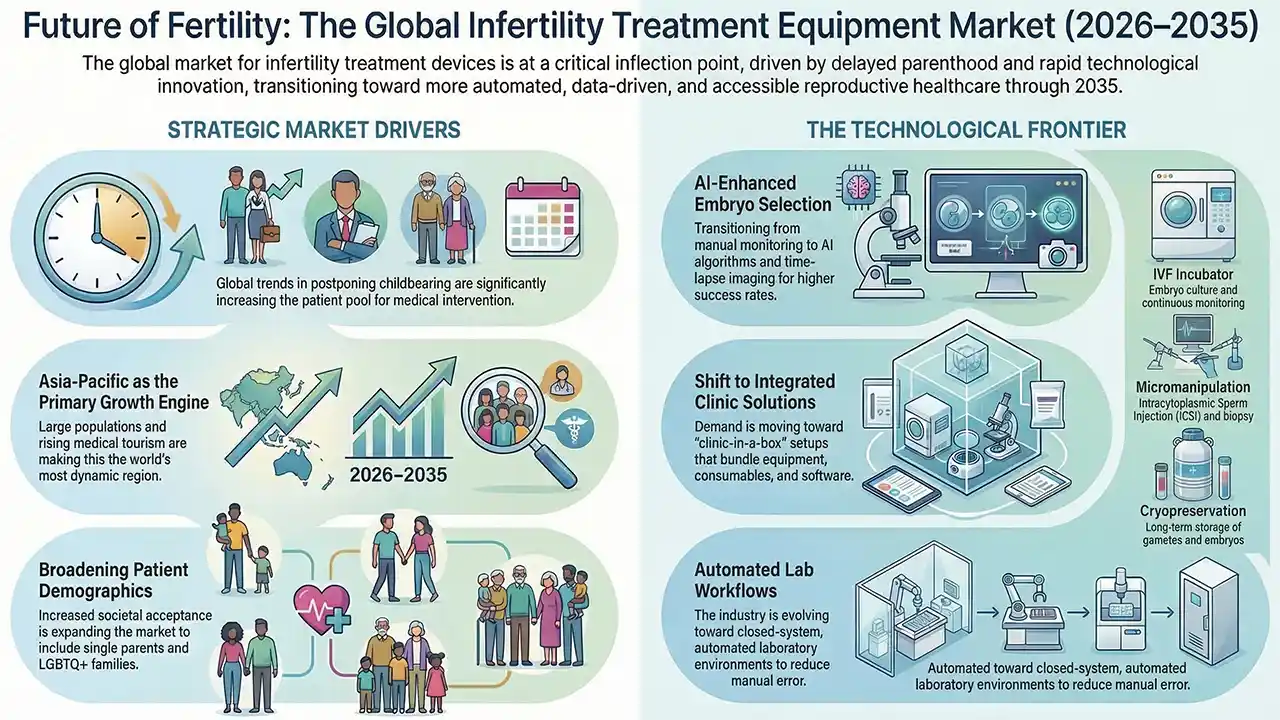
An analysis of the global infertility treatment devices and equipment industry through 2035. It examines critical market drivers such as delayed childbearing, technological innovations in AI and automation, and regional growth patterns, offering strategic insights into the evolving landscape of assisted reproductive technology worldwide.

Human preimplantation embryo arrest in ART remains a major challenge in IVF, affecting early embryo development and success rates. Driven by genetic mutations, epigenetic disruptions, and metabolic failures, this condition halts growth before implantation, prompting advances in AI-based embryo selection and precision medicine to improve reproductive outcomes.
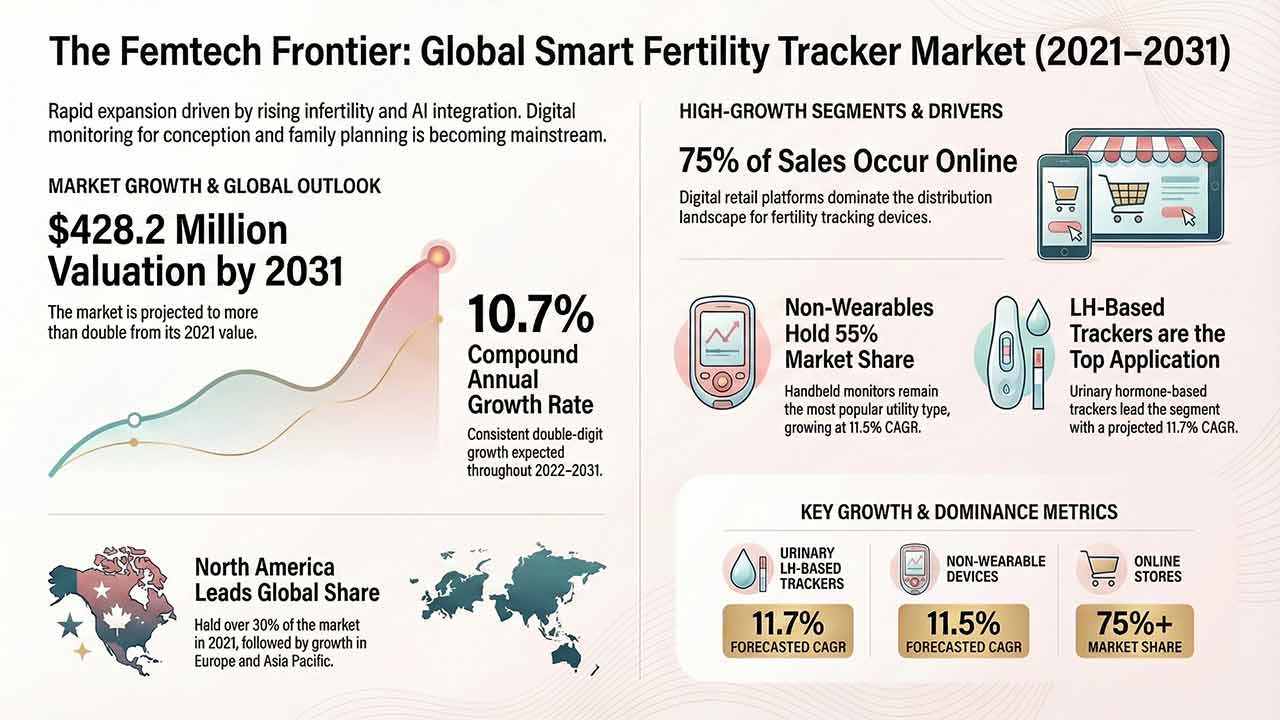
This comprehensive report analyses the Smart Fertility Tracker Market, detailing its projected growth from US$ 160.2 million in 2021 to US$ 428.2 million by 2031. It examines key drivers such as rising infertility and technological advancements in AI-integrated hormone monitoring, alongside detailed segmentation by utility, application, and region.

Gen Z women fertility awareness is marked by high anxiety but limited clinical knowledge, according to new ASRM-published research. While most young women want children, many misunderstand IVF success rates, miscarriage risks, and age-related decline, highlighting an urgent need for proactive, evidence-based reproductive education initiatives.
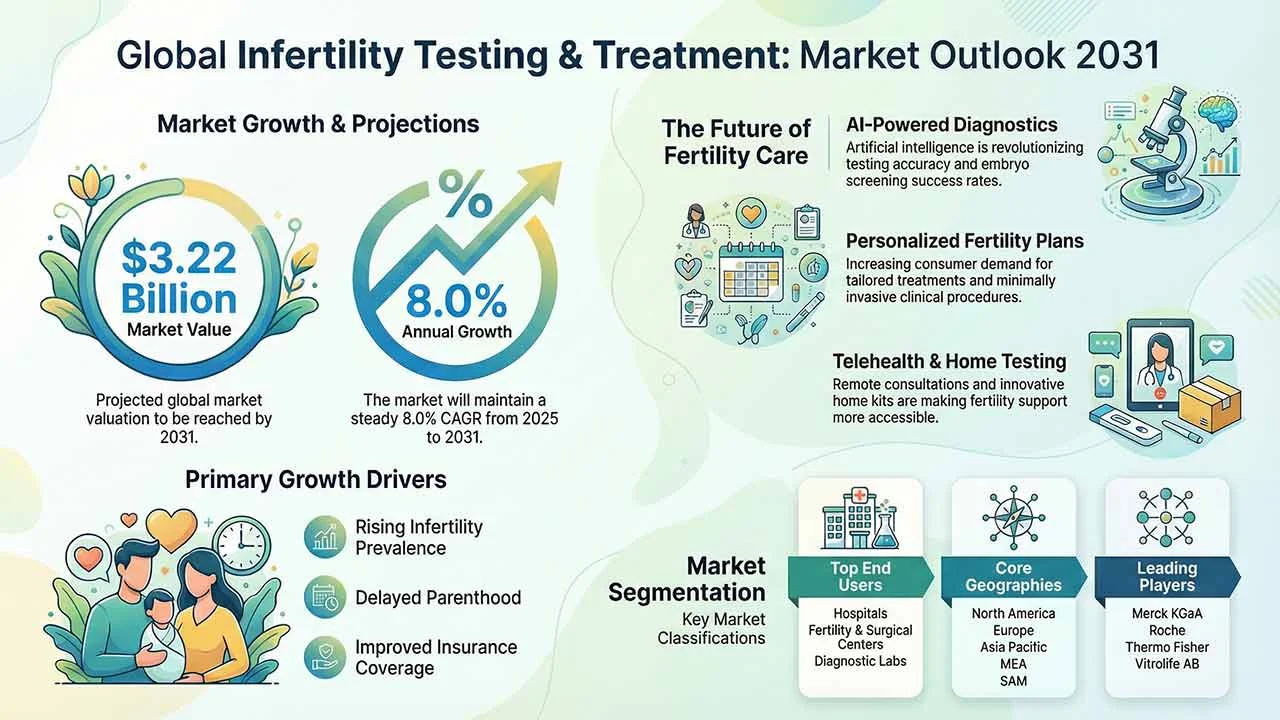
The global infertility testing and treatment market is projected to reach US$3.22 billion by 2031, expanding at an 8% CAGR. Growth is fueled by delayed parenthood, rising infertility rates, AI-driven diagnostics, advanced ART procedures, and expanding healthcare access across North America, Europe, and Asia-Pacific regions.

Market analysis of the infertility drugs market, highlighting the dominance of gonadotropins, online pharmacies as key channels, the competitive landscape, and regional trends, with insights and infographics for 2025-2032.

The Human Reproductive Technologies market is poised for steady growth through 2032, driven by strategic moves from leading players, segmentation expansion, and region-specific demand shifts.