Home
 NewsNews
A new review highlights the link from Forever Chemicals to reduced ART outcomes, showing how PFAS exposure impacts fertility, pregnancy, and reproductive health. The findings raise urgent concerns for IVF patients and call for stronger regulation, deeper research, and systemic action to address environmental risks in reproductive medicine.




A newly published narrative review in F&S Reviews, an official journal of the American Society for Reproductive Medicine (ASRM), has drawn urgent attention to the reproductive health risks posed by per- and polyfluoroalkyl substances, widely known as PFAS or "forever chemicals". The review provides a comprehensive examination of how PFAS exposure may affect female fertility, pregnancy, and birth outcomes and specifically underscores the link from forever chemicals to reduced ART outcomes, raising serious concerns for patients undergoing assisted reproductive technology.
PFAS are a large and diverse class of synthetic compounds that have been commercially manufactured and used since the 1940s. Their applications are broad and deeply embedded in everyday life, from firefighting foams and stain-resistant coatings to non-stick cookware and food packaging. What makes these chemicals particularly concerning from a public health standpoint is their remarkable chemical stability: the very property that makes them commercially valuable also enables them to persist indefinitely in both the environment and the human body. According to the CDC, nearly all people in the United States have detectable levels of PFAS in their blood, a sobering metric that underscores the scale of population-wide exposure.

One of the most significant findings of the review is that PFAS are capable of crossing critical physiological barriers and accumulating directly within reproductive tissues. Researchers found that these chemicals are repeatedly detected in follicular fluid, amniotic fluid, placental tissue, and breast milk, environments that are central to conception, fetal development, and early infant nutrition. This bioaccumulation in the reproductive ecosystem positions PFAS as a pervasive and persistent threat to maternal and infant health, not merely an environmental contaminant at a distance.
The review places particular emphasis on how preconception PFAS exposure disrupts the biological foundations of fertility. Evidence cited in the study links PFAS exposure to diminished ovarian reserve, hormonal disruption, and measurably poorer outcomes for patients undergoing assisted reproductive technology. The documented link from forever chemicals to reduced ART outcomes is especially significant for the growing number of individuals and couples who rely on IVF and related procedures to conceive. When the ovarian environment itself is compromised by PFAS accumulation, the downstream effects on egg quality, embryo development, and implantation success are difficult to isolate and difficult to reverse.
The reproductive risks associated with PFAS exposure do not end at conception. During pregnancy, the review associates PFAS exposure with serious and potentially life-threatening complications, including preeclampsia, fetal growth restriction, and preterm birth, outcomes that carry long-term consequences for both mother and child. Beyond acute pregnancy risks, PFAS exposure has also been linked to complex reproductive disorders, including polycystic ovary syndrome (PCOS) and endometriosis, both of which are leading contributors to female infertility worldwide.
A particularly critical dimension of the review is its cautionary assessment of newer PFAS replacement chemicals. As regulatory pressure has mounted against legacy PFAS compounds, industry has increasingly introduced structurally modified alternatives, yet the authors warn that these substitutes do not consistently appear less hazardous. The review explicitly highlights the risk of what researchers term "regrettable substitution": the introduction of chemically similar compounds without sufficient evidence that they are safer for human health or the environment. This finding is especially relevant to clinicians and policymakers as they navigate the expanding PFAS chemical landscape.
In response to these findings, including the well-documented pathway from forever chemicals to reduced ART outcomes, the authors put forward a clear and actionable regulatory agenda. They call for outcome-based safety evaluation of PFAS compounds before commercial use, class-based regulatory approaches that treat PFAS as a chemical family rather than evaluating each compound in isolation, and expanded research into the cumulative effects of PFAS mixtures and the underexplored domain of paternal PFAS exposure. These recommendations signal a need for systemic reform that goes beyond individual consumer choices and extends into industrial regulation, clinical guidance, and public health infrastructure.
As PFAS contamination continues to be identified across drinking water supplies, consumer goods, and food packaging at a global scale, the reproductive medicine community faces an increasingly urgent imperative to understand, communicate, and act on the evidence linking environmental chemical exposure to infertility and maternal health outcomes.


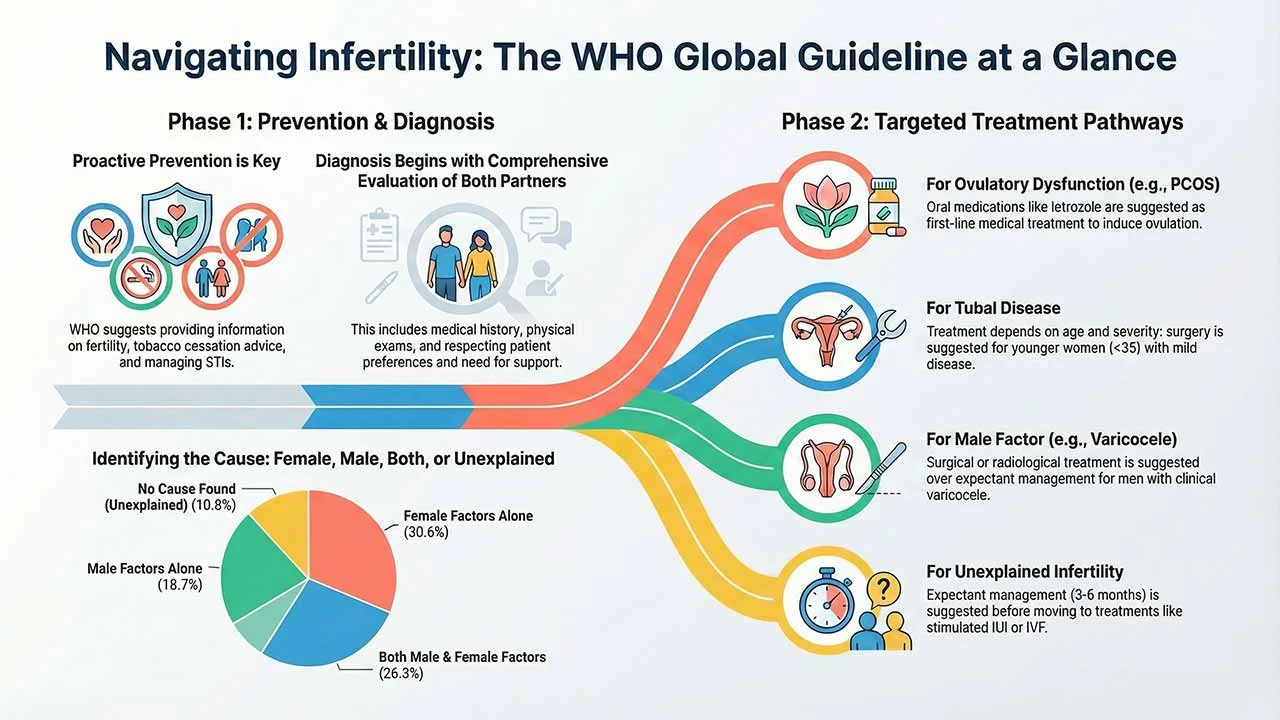
The World Health Organization releases its first comprehensive, evidence-based global guideline for infertility prevention, diagnosis, and treatment. Addressing one in six people of reproductive age worldwide, the guideline emphasizes equity, human rights, and standardized interventions to improve access to fertility care globally.

Gameto has secured $44 million in Series C funding to advance its stem cell-derived fertility therapy, Fertilo, into Phase 3 trials, marking a significant milestone in reproductive healthcare. This groundbreaking therapy uses induced pluripotent stem cell technology to mature eggs outside the body, significantly reducing hormonal stimulation and enhancing safety and efficacy in fertility treatments.

INVO Fertility partners with Heidi Health to integrate an AI-powered scribe at Wisconsin Fertility Institute, streamlining documentation so clinicians focus on care.
With ART Fertility Clinics now part of its network, IVI RMA Global has created a Middle East operating region to meet growing fertility needs. The integration boosts treatment capacity, scientific output, and care consistency across the UAE and Saudi Arabia as demographic pressures shape demand for assisted reproduction

California SB 729 now requires insured large employers to provide comprehensive coverage for infertility and IVF starting from 2026, significantly increasing workplace benefits.

Renew Biotech confirms being a clinical testing provider for NOA Guide by Path Fertility, offering advanced evaluation for men with non-obstructive azoospermia, a form of male infertility.

The Relocation of Westminster Fertility Clinic to Long Beach by RPMG will expand access and improve specialized services for the Southern California region.