Home
 VideoVideo
Embryo donation and adoption provides a unique path to parenthood, allowing families to experience pregnancy using donated embryos. With strong clinical success rates, secure legal frameworks, and growing global accessibility, this approach offers hope to individuals, couples, and diverse family structures seeking an alternative to traditional fertility treatments.


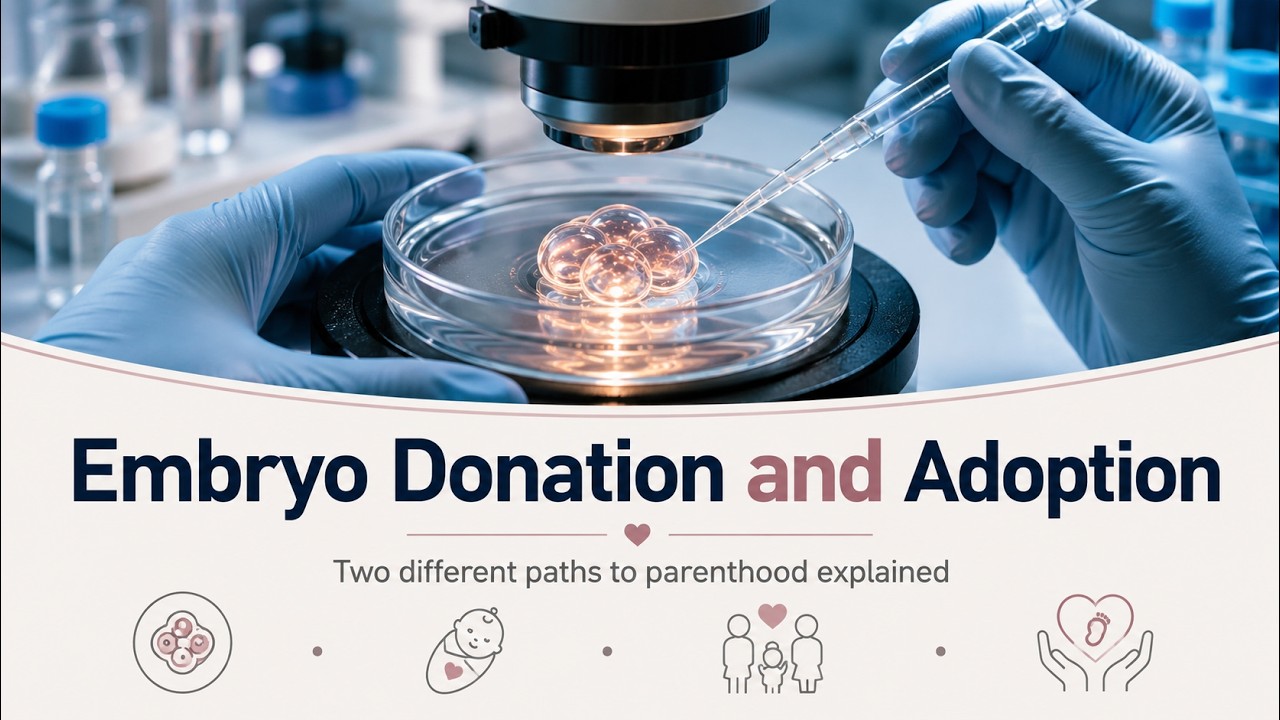
For many individuals and couples, the path to parenthood is a winding journey that often involves navigating the complexities of reproductive medicine. When traditional methods like in vitro fertilization (IVF) do not lead to the desired outcome, a relatively new but increasingly common option emerges: embryo donation and adoption. This path offers a unique opportunity for families to experience pregnancy and childbirth while using embryos that have been generously donated by others who have completed their own family-building journeys. Choosing this route means moving beyond biological links to embrace the profound connection of providing a home, a heartbeat, and a lifetime of love to a child.
If you are beginning to explore this field, the terminology can initially seem interchangeable, yet "embryo donation" and "embryo adoption" represent different frameworks within the same medical process. Understanding these distinctions is crucial for selecting the program that best aligns with a family's values and needs.
Embryo donation is primarily defined by a medical and legal framework. In the United States, the Food and Drug Administration (FDA) regulates this process as a form of tissue donation. The focus is on clinical efficiency, medical screening of donors, and the legal transfer of rights and responsibilities through contracts. This path is often managed directly by fertility clinics, which handle the matching process and the subsequent medical treatments in-house, generally resulting in a shorter timeline of approximately two to three months once an embryo becomes available.
In contrast, "embryo adoption" is a term used largely by agencies and faith-based organizations that view the embryo through the lens of traditional child adoption. This model includes a more rigorous social framework, often requiring a "home study" similar to those found in infant adoption, along with personalized matching between the donor and recipient families. Because of these additional layers of screening and the depth of the matching process, the timeline for an agency-led journey typically extends to eight to 14 months. While medical societies like the American Society for Reproductive Medicine (ASRM) clarify that "adoption" is a social term rather than a legal one in this context, many families find the language more reflective of their emotional intent. Regardless of the terminology used, the legal foundation remains a medical donation supported by a robust contract.
Embryo donation and adoption serves as a versatile solution for a wide variety of family structures and medical situations. It is often a primary choice for those facing "dual-factor infertility," where both partners have significant reproductive challenges that make the creation of new embryos difficult or impossible. Furthermore, it offers a vital alternative for individuals of advanced maternal age, specifically those over 40, whose own egg quality may have declined, but who are otherwise healthy and eager to carry a pregnancy to term.
The program also provides hope for those who have experienced recurrent pregnancy loss or repeated implantation failure with their own embryos, offering a fresh start with donor embryos that may have higher genetic potential. Beyond infertility, this path is chosen by families who carry known genetic conditions they wish to avoid passing on to the next generation. Additionally, it has become an increasingly accessible option for solo parents by choice and same-sex couples, who may find shorter wait times through this route compared to traditional infant adoption.
The medical process involved in receiving a donated embryo is often considered simpler than a full IVF cycle because the complex steps of egg collection and fertilization have already been completed. The recipient’s focus is entirely on preparing the body to receive the embryo.
The journey begins with an initial appointment where the medical history is reviewed and preferences for the embryo's background, such as ethnicity and genetic history, are discussed. Following this, a fertility assessment is conducted to confirm that the recipient's health and uterine environment are suitable for pregnancy.
The third and perhaps most critical clinical phase is endometrial preparation. Using supplemental estrogen and progesterone, doctors help the recipient build a thick, receptive uterine lining designed to support successful implantation. Some clinics may then suggest an optional Endometrial Receptivity Analysis (ERA) test to fine-tune the timing of the transfer to match the individual's specific "implantation window".
On the day of the procedure, the lab team thaws the embryo using advanced vitrification techniques, which boast very high survival rates in modern reproductive medicine. The transfer itself is a brief, 15-minute procedure where the doctor uses a thin catheter to place the embryo into the uterus under ultrasound guidance. Finally, a blood test for beta-hCG is performed 10 to 14 days later to determine if the pregnancy has been successfully established. To ensure the safest outcome, many programs now prioritize "elective single embryo transfer" (eSET), which focuses on transferring one high-potential embryo to reduce the risks associated with multiple births.
The efficacy of embryo donation and adoption is well-supported by significant clinical data. Large-scale U.S. registry data involving more than 8,700 frozen embryo transfers indicate a live birth rate of approximately 44% per transfer. These success rates are remarkably consistent with those seen in younger IVF patients using their own eggs.
Research published in the American Journal of Obstetrics & Gynecology highlights that the primary driver of success is the age of the egg at the time of its retrieval. When embryos originate from eggs retrieved from donors under age 35, pregnancy rates can reach 54%. Even when embryos come from older donors (age 38 or older), pregnancy rates remain strong at roughly 49%. This data suggests that while the recipient's age can influence pregnancy risks, the embryo's ability to implant is largely determined by the age of the egg provider.
Furthermore, the outcomes for children born through these programs are very encouraging. Studies show that 84% of births following donated-embryo transfers are singletons, and approximately 77% of these babies are born at full term with healthy birth weights. These statistics provide peace of mind to intended parents regarding the medical safety and viability of the path.
A frequent concern for intended parents involves the legal stability of their family and whether genetic parents could later claim rights to the child. However, in both the United States and much of Europe, the process is governed by stringent legal contracts. Donors sign documents that explicitly relinquish all rights and duties toward any child born from the embryos.
Once the transfer occurs and the recipient gives birth, she is legally recognized as the mother in most jurisdictions. Her spouse or partner can then be listed as the second parent on the birth certificate, ensuring the legal foundation of the family is secure from the moment of birth. While the process is well-defined, it is highly recommended that families consult with a fertility law specialist to review contracts and ensure that their parentage is fully protected across state or international borders.
The emotional landscape of embryo donation and adoption is as important as the medical one. Many intended parents experience a mix of grief over the loss of a genetic connection alongside profound hope for the child they will carry. Research suggests that these initial anxieties do not negatively impact the child’s development or the parent-child bond.
In fact, follow-up studies comparing embryo donation families to IVF and traditional adoption families found that children born through embryo donation do not show higher risks of psychological or behavioral problems. Standard child behavior scores remain within normal ranges, suggesting that these children are socially and emotionally well-adjusted.
Furthermore, bonding is not dependent on genetic ties. Parents build deep connections through the physical experiences of pregnancy, childbirth, and daily caregiving. Interestingly, some studies indicate that donor-conceived families may exhibit higher levels of parental warmth and involvement, often because of the long and intentional journey they took to achieve parenthood. Current professional guidance from organizations like ESHRE also supports transparency, recommending that parents share age-appropriate stories of their child's origins to build a foundation of trust and a healthy sense of identity.
The experience of embryo donation varies significantly depending on the region and local regulations. Families often look beyond their own borders to find programs that match their specific requirements regarding anonymity and eligibility.
In some countries, such as the United States and Mexico, clinics are permitted to use Preimplantation Genetic Testing for Aneuploidy (PGT-A) to identify the sex of an embryo, which can be shared with parents for "family balancing". Conversely, many European countries prohibit sex selection for non-medical reasons and strictly use PGT to screen for serious genetic conditions.
The availability of diverse donor backgrounds also fluctuates by region. Programs in the U.S., Spain, and Portugal are often noted for their inclusivity, welcoming single parents and same-sex couples, whereas other regions may have more restrictive local laws regarding who can access donated embryos. For those looking to ensure that future siblings share the same genetic background, some international programs offer the option to secure a "sibling cohort" of embryos from the same donors.
Embryo donation and adoption represents a remarkable intersection of scientific achievement and human generosity. It is a path that honors the desire for pregnancy and the deep-seated calling to parent, while recognizing that a family's true essence is not defined by DNA. Whether a family chooses the clinical efficiency of a donation program or the social framework of an adoption-style matching process, they are embarking on a journey that transforms a spark of potential into a lifelong bond. In the end, parenting is found in the quiet, daily moments, the rocking of a child, the first day of school, and the values passed down through generations, proving that the story of a family is written by the love that sustains it.