Home
 ArticlesArticles
New polling reveals overwhelming American opposition to Silicon Valley's unregulated embryo-screening for non-medical traits. Four in five voters express concerns about IQ and cosmetic selection technology. Bipartisan majorities support regulatory action to prevent commodification of children, with Trump voters showing strongest desire for prohibition.



The confluence of fertility treatments and advanced genetic algorithms has propelled society into an unprecedented bioethical challenge. Backed by billions of dollars in funding from Big Tech, multiple startups in Silicon Valley purport to give would-be parents the ability to screen embryos created via in vitro fertilization (IVF) to ascertain their propensity for various non-medical outcomes, including predicted intelligence, physical appearance, personality, and health conditions.
Yet, far from embracing this new era of "responsible parenthood", Americans are registering profound skepticism. The 2025 EPPC/YouGov Future of the Family Survey reveals a decisive consensus across the political and demographic spectrum: the vast majority of voters have significant concerns about the future implications of this technology. This widespread anxiety presents a formidable challenge to lawmakers aiming to preserve parenthood from the emerging market that threatens to turn embryos into commodities.
The technology at the heart of this controversy involves pre-implantation genetic testing that utilizes predictive algorithms. While supporters promise parents the chance to select an embryo "made to order", critics argue that these high-profile fertility screening startups are merely offering the ability to "hack" reproduction.
The fundamental ethical dispute lies in the methodology: these firms are not curing disease or enhancing abilities in the womb; they are simply discarding embryos that do not make the cut. If culturally normalized and allowed to achieve economies of scale, these tools could radically change the nature of parenthood, transitioning would-be parents from recipients of the gift of a new child to consumers looking for a product.
The potential ramifications extend beyond individual choice. If diseases are systematically screened out, it could undermine social support and research funding for those diseases, casting parents who have children naturally as taking an unacceptable risk.
The EPPC/YouGov Future of the Family Survey, a nationally representative online poll of 1,100 adults (with an oversample of adults age 18–45), provides clear evidence of public disquiet.
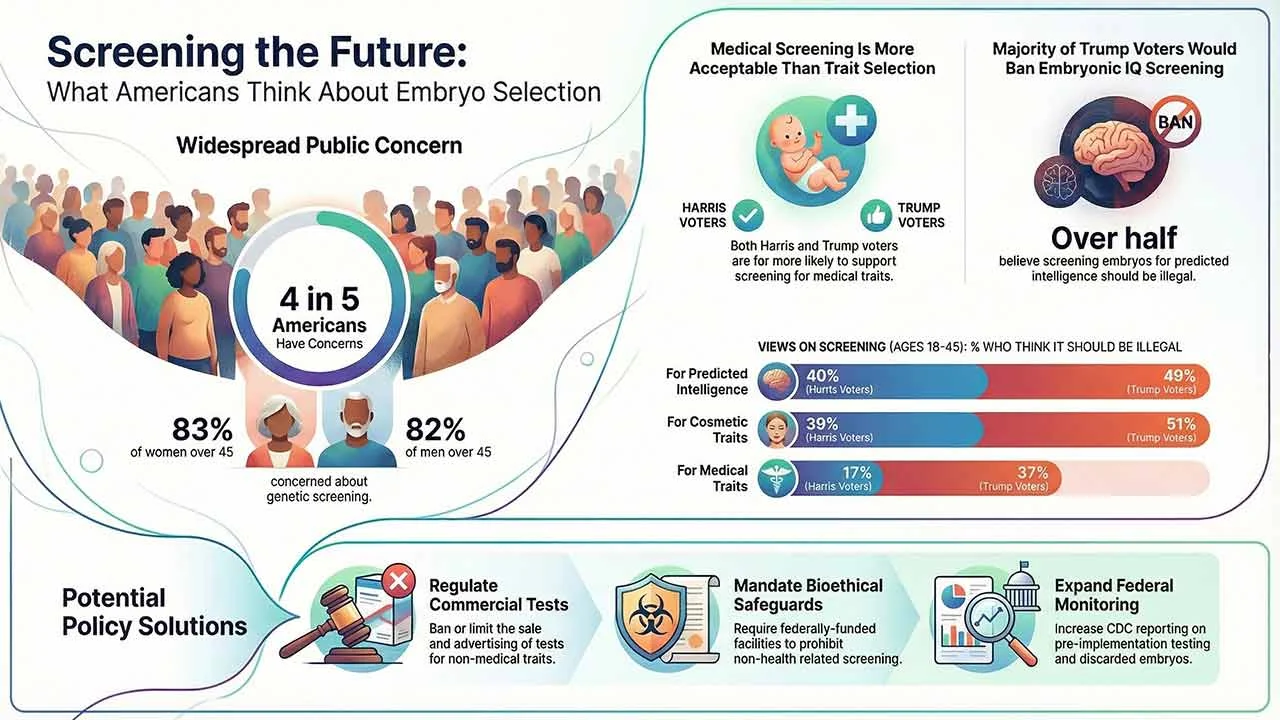
Key Takeaway: Four in five voters have at least some concerns about the future of embryo screening.

Overall, four in five respondents to the survey said they had at least some concerns about the way embryo screening technology could be used.
Furthermore, when asked about views on allowing parents to choose their embryo’s characteristics, such as eye color, IQ, or athletic ability, women generally expressed greater concern than men, regardless of educational attainment.

This data confirms that the anxieties regarding the broader implications of these technologies are profound and widespread across gender and age groups. Very few Americans want Silicon Valley to "hack" reproduction. Only a small minority of Americans currently say they desire to utilize this kind of genetic screening.
While support for measures to help infertile couples have children exists, the concerns escalate dramatically when the screening moves from treating congenital disease to selecting for non-medical, elective traits. The poll assessed voters' stances on whether specific applications of embryo screening should be illegal, okay but unused, or gladly legal and used.
The screening of embryos for predicted intelligence (embryonic IQ screening) emerged as a particularly controversial application. The data reveals strong cross-partisan desire for regulatory action against these elective uses.

The strongest desire for outright prohibition among Trump voters aged 18-45 concerns screening for cosmetic traits (51% illegal), closely followed by screening for predicted intelligence (49% illegal)
When focusing specifically on Trump voters, a majority would bar embryonic IQ screening

These figures demonstrate significant political appetite, especially among the political right, for regulatory intervention against screening for intelligence.
Even among voters most aligned with the current administration (Harris voters age 18-45), 40% believe screening embryos for predicted intelligence should be illegal. This indicates that commonsense regulations have potential for support across demographic groups.
In stark contrast, when it comes to screening embryos for predicted medical traits (like congenital disease or inherited disorders), while 37% of Trump voters still believe it should be illegal, only 17% of Harris voters agree, suggesting broad acceptance of using the technology to mitigate severe health risks.
The sources highlight that an era of unfettered embryonic screening could usher in eugenic pressures and profoundly remake the relationship between parents and children. To address this challenge and ensure that technologies are not leveraged to turn embryos into commodities, lawmakers are being urged to consider specific policy actions.
A pro-family, pro-life Congress would seek to preserve parenthood by banning or regulating the kinds of pre-implantation genetic testing that promote elective selection.
The sources recommend that lawmakers consider three primary regulatory pathways:
These proposed measures reflect a political commitment to preventing the cultural normalization of tools that threaten to commodify life. The strong polling data on concern and the desire to prohibit elective traits like IQ screening indicate that such regulatory moves could attract bipartisan support necessary to renew culture and shape policy.
The data from the EPPC/YouGov Future of the Family Survey is a clear warning sign: while Americans support reproductive health measures, they are wary of Silicon Valley's unregulated embryo-screening and the commercial imperative attempting to dictate the characteristics of future generations. The public views the selection of embryos for non-medical traits such as IQ or cosmetic features as a step too far, risking the transformation of the child from a gift to a customizable product.
The policy challenge is urgent: if Silicon Valley's unregulated embryo-screening continues unchecked, the share of Americans using these tools is likely to grow over time. By considering commonsense regulations aimed at restricting the commercialization of elective genetic screening, lawmakers have a path forward supported by broad public concern to prevent society from becoming less welcoming of those whose genetic tests don't show up as "perfect".



Immunotherapy in restoring human fertility is emerging as a promising approach for addressing immune-related reproductive disorders. Recent clinical advances highlight its potential to improve implantation, pregnancy outcomes, and reproductive health, offering renewed hope for patients facing infertility linked to immune system dysfunction.

The smart fertility tracker market has transformed male fertility diagnostics, but how reliable are these devices? This report examines what at-home sperm tests actually measure, where they fall short compared to clinical analysis, and how men and couples can use them appropriately within a broader reproductive care pathway.

The distinct assisted reproductive technologies of Intrauterine Insemination (IUI), In Vitro Fertilization (IVF), and Intracytoplasmic Sperm Injection (ICSI). It outlines how each procedure works, the medical indications for their use, and their respective success rates. The importance of choosing the right treatment based on factors such as patient age, infertility diagnosis, and personal circumstances.

Assisted Reproductive Technology (ART), a groundbreaking medical field that provides solutions for individuals and couples facing fertility challenges. It defines ART, explains its core techniques such as In Vitro Fertilization (IVF) and Intracytoplasmic Sperm Injection (ICSI), and discusses clinical applications and success rates.

Common questions about pregnancy with polycystic ovary syndrome (PCOS) through IVF and IUI. It discusses PCOS-related infertility, success rates, treatment options, and the importance of personalised protocols. Emphasising holistic care and emotional support, it offers hope and insights for women navigating the challenges of PCOS.

The potential of stem cells to improve ovarian reserve and egg quality, focusing on their application in women with diminished fertility. It discusses how mesenchymal stem cells and other stem cell therapies can rejuvenate ovarian function by enhancing the ovarian environment, promoting tissue repair, and stimulating follicle growth. While the therapy shows promise, the article emphasizes the need for more extensive studies to understand its efficacy and safety.
Clinical pearls for treating infertility and low testosterone in men, emphasizing reproductive goal assessment, empiric medical therapies, and comprehensive multidisciplinary management strategies.